
You’ve just finished your +2 exams. Now what?
You could pursue a generic bachelor’s degree, or you could choose a path that leads to international opportunities, premium salaries, and a career that takes you anywhere in the world. Welcome to ACCA—the global professional accountancy qualification that’s transforming how Nepali students think about their accounting careers.
But here’s the thing: ACCA isn’t just another professional course. It’s a strategic decision that will shape the next decade of your professional life. This guide cuts through the confusion, answers your real questions, and shows you exactly why thousands of Nepali students are choosing ACCA over traditional routes.
Why ACCA Is Rising in Nepal
Walk into any Big 4 audit firm in Kathmandu, and you’ll notice something interesting. The ambitious young professionals working on international clients? Many of them are ACCA-qualified. Why?
Because Nepal is changing.
For decades, accounting in Nepal meant one thing: becoming a CA (Chartered Accountant) through ICAN. That path worked fine when Nepal’s economy was closed and insular. But today? Nepal is globalizing. Multinational companies are setting up operations in Kathmandu. Tech startups are raising funds from international investors. Outsourcing firms are expanding rapidly. Banks are adopting international financial reporting standards.
And these organizations don’t want just any accountant. They want professionals who understand global standards, who can hit the ground running in their international teams, and who won’t need 2 years of “learning our global systems.”
That’s where ACCA comes in.
The ACCA Advantage: Market Demand & Earning Power
- ACCA is recognized in 180+ countries—not just Nepal
- Big 4 firms in Nepal actively recruit ACCA professionals for their international practices
- Multinational companies in Nepal explicitly seek ACCA-qualified candidates
- Starting salaries for ACCA graduates in Nepal average NPR 50,000-80,000/month—that’s 2-3x what untrained finance staff earn
- Within 5 years, ACCA professionals in senior roles earn NPR 2,50,000-5,00,000/month
But salary is just one part of the story.
What Really Makes ACCA Different in Nepal
1. You Can Study While Earning
Unlike CA, where articleship is mandatory and often unpaid in the first year, ACCA’s structure means you can start earning from day one. Many ACCA students in Nepal work in finance roles (earning NPR 8,000-16,000/month) while studying. Over 3 years, that’s NPR 4,20,000 in earnings that directly offsets your study costs.
Do the math: Total ACCA cost is approximately NPR 6.88 lakhs. Subtract your 3-year earnings of NPR 4.20 lakhs, and your net investment drops to just NPR 2.68 lakhs. You’re basically getting a world-class qualification for less than a motorcycle!
2. You’re Not Locked Into Audit
CA in Nepal? That’s primarily an audit pathway. Hospitals need CAs. The government needs CAs. Traditional audit firms need CAs. But if you want to work in investment banking, corporate finance strategy, business consulting, or lead a startup’s finance team? ACCA opens more doors.
3. Speed
CA takes 5+ years. ACCA takes 3-4 years. That means you enter the job market earlier, start earning sooner, and build experience faster. By the time a CA student is finishing their articles, an ACCA graduate is already 2 years into a finance career.
4. The Flexibility
ACCA exams happen 4 times per year (March, June, September, December). You can sit for multiple exams per session. Have a bad exam? You can retake it in 3 months, not wait a full year. Got a job opportunity that requires you to pause studies for 6 months? Pause. No problem.
This flexibility is crucial in Nepal where life circumstances change quickly—family situations, job relocations, opportunities that pop up unexpectedly.
ACCA Course Structure & Duration
You need to understand what you’re getting into.
The Three Levels
Level 1: Applied Knowledge (9 months) — The Foundation Stage
This level teaches you how accounting actually works. You’ll study three papers:
- Business and Technology (BT):
- Management Accounting (MA):
- Financial Accounting (FA):
These three papers aren’t theoretical nonsense. They teach practical skills you’ll use on day one of a finance job. Many students find FA particularly useful because it’s the foundation everything else builds on.
Level 2: Applied Skills
Six papers covering the bread-and-butter of accounting:
- Corporate and Business Law (LW):
- Performance Management (PM):
- Taxation (TX):
- Financial Reporting (FR):
- Audit and Assurance (AA):
- Financial Management (FM):
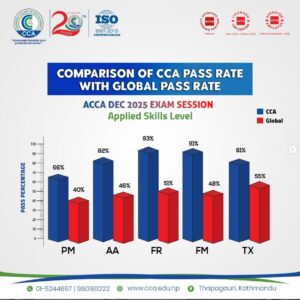
This level is challenging. But CCA’s 85%+ pass rate proves it’s very doable with proper guidance.
Level 3: Strategic Professional
Four papers total, but you choose your specialization:
Mandatory papers (everyone takes these):
- Strategic Business Leader (SBL):
- Strategic Business Reporting (SBR):
Choose 2 from these options based on your career goals:
- Advanced Financial Management (AFM):
- Advanced Performance Management (APM):
- Advanced Taxation (ATX):
- Advanced Audit and Assurance (AAA):
Here’s where ACCA’s flexibility shines. You can tailor your final papers to match your career aspirations. Want to work in a bank? Choose AFM. Want to consult? Choose APM.
Beyond the Exams: Two Critical Requirements
Ethics and Professional Skills Module (EPSM):
This isn’t boring ethics training. It’s 8-10 hours online covering real scenarios: “What do you do when your boss asks you to hide information?” “How do you lead when you disagree with senior management?” It’s designed to prepare you for ethical dilemmas you’ll actually face in your career.
Practical Experience Requirement (PER):
You need 36 months (3 years) of relevant work experience. The good news? This doesn’t have to be unpaid. Most ACCA students in Nepal work in finance roles earning NPR 8,000-16,000/month while building PER hours. It’s not forced unpaid slavery like some other paths require.
Eligibility & Entry Routes
If you have +2: You’re eligible. It doesn’t matter if you studied science, management, or humanities. ACCA doesn’t require prior accounting knowledge.
If you have a bachelor’s degree in anything: You’re eligible. BBS, engineering, agriculture, psychology—doesn’t matter. You’ll likely qualify for exemptions that skip you ahead.
If you have an MBA or Master’s: Even better. You’ll probably skip the entire Applied Knowledge level.
If you’ve started ICAN (CA) but want a faster route: You might qualify for exemptions. Some papers overlap.
The Exemption Game (Save 6-12 Months)
Here’s where many students miss out on savings:
- BBS graduates: typically exempt from 3-5 papers
- BBA/BCom graduates: typically exempt from 2-4 papers
- MBA/Master’s holders: typically exempt from 5-7 papers
- ICAN CAP I passers: typically exempt from 2-3 papers
How to get exemptions?
- Submit certified copies of your academic transcripts
- Pay exemption fee per paper (approximately £89 per paper ≈ NPR 1,500-2,000)
- ACCA UK reviews and confirms within 4-6 weeks
Example: A BBS graduate exempting 4 papers saves:
- Time: 12-15 months of study
- Cost: NPR 50,000-70,000 in tuition + exam fees
This is why it’s critical to get proper exemption guidance from your learning partner (CCA can help).
ACCA Cost in Nepal – Full Breakdown
Let’s break down the exact cost so there are zero surprises.
Registration & Admission
| Item | Cost (NPR) |
| Admission Fee | 25,000 |
| ACCA Global Registration | £45 ≈ 8,500 |
| Subtotal | 33,500 |
Tuition Fees (CCA College Rates)
| Level | Cost (NPR) |
| Applied Knowledge + LW | 115,000 |
| Applied Skills (5 papers) | 85,000 |
| Strategic Professional | 55,000 |
| Books (Applied Skills + SP) | 15,000 |
| Subtotal | 270,000 |
ACCA Exam Fees (Set by ACCA UK)
| Level | Cost (GBP) | Cost (NPR) |
| Applied Knowledge | £360 | 59,400 |
| LW Exam | £180 | 29,700 |
| Applied Skills | £735 | 121,275 |
| Strategic Professional | £815 | 134,475 |
| Subtotal | £2,090 | 344,850 |
TOTAL INVESTMENT: NPR 6,88,500 (Approximately NPR 6.88 lakhs)
But wait—here’s the magic part:
How This Cost Gets Cut in Half
Remember that 36-month practical experience requirement? During those 3 years, you’ll be working. And earning.
Typical Articleship Stipends in Nepal:
| Year | Monthly Stipend | Annual Income |
| Year 1 | NPR 8,000 | NPR 96,000 |
| Year 2 | NPR 11,000 | NPR 132,000 |
| Year 3 | NPR 16,000 | NPR 192,000 |
| Total | — | NPR 4,20,000 |
Net Cost Calculation
- Total investment: NPR 6,88,500
- Less 3-year earnings: (NPR 4,20,000)
- Net out-of-pocket: NPR 2,68,500
This is the critical number. Your actual cost is less than NPR 2.7 lakhs. That’s less than most decent motorcycles, and you’re investing in a global qualification that’ll add millions to your lifetime earnings.
How Nepali Students Pay ACCA Fees
- Installment-based tuition plans
- Pay-per-level fee structure
- Scholarships and merit-based discounts
- Early registration savings
CCA College supports students with transparent fee structures and flexible payment options.
ACCA vs ICAN (CA) – Which Is Better in Nepal?
| Factor | ACCA | CA |
| Duration | 3-4 years | 5+ years |
| Exam Frequency | 4x/year | 2x/year |
| Global Recognition | 180+ countries | Mainly Nepal |
| Total Cost | 6.88 lakhs | 4-5 lakhs |
| Net Cost | 2.68 lakhs (after earnings) | 3-4 lakhs |
| Starting Salary | NPR 50,000-80,000 | NPR 45,000-75,000 |
| Audit Authority | No (in Nepal) | Yes |
| International Jobs | Excellent | Limited |
| Study While Working | Yes (design) | Limited |
| Career Options | Broad (finance, banking, consulting) | Primarily audit |
The Real Question: Why Not Both?
Here’s what smart Nepali professionals are doing: Starting with ACCA, then adding CA.
Why? Because:
- ACCA is faster (3-4 years), so you build experience and start earning quicker
- ACCA gives global options while you’re building career
- CA’s local expertise becomes valuable once you understand global standards
- Some ACCA papers exempt you from CA papers, saving time
- ACCA + CA combination makes you the most hire-able candidate in Nepal
The professionals who do this become unstoppable: global credibility (ACCA) + local expertise (CA) = premium roles and maximum earning potential.
Best ACCA College in Nepal

With over 6 ACCA learning providers in Nepal, selecting the right institution dramatically impacts success rates, study experience, and career launchpad.
What Separates Average ACCA Colleges from High-Performing Ones
Many average ACCA colleges tend to:
- Hire teachers who just “know accounting”
- Follow textbook curriculum without exam focus
- Large batches with no personalized attention
- No connection to industry
- Students fail and retake exams multiple times
High-performing ACCA colleges typically offer:
- Hire ACCA members and CAs with industry experience
- Teaching is explicitly exam-focused
- Small batches with mentorship
- Direct connections to employers for internships
- Students pass exams first attempt at high rates
Why CCA Is One of the Best ACCA Colleges in Nepal
CCA isn’t just another coaching center. Here’s what sets it apart and makes it the best ACCA college in Nepal:
1. Platinum Approved Learning Partner Status
ACCA doesn’t give this to everyone. There are three tiers:
- Gold partners = okay
- Silver partners = good
- Platinum partners = exceptional
CCA is Platinum Partner. This means ACCA UK has audited CCA multiple times and confirmed:
- Consistently high pass rates
- Quality faculty
- Excellent student outcomes
- Institutional excellence
This status is earned over years of consistent performance, not handed out freely.
2. Actual Numbers: 85%+ Pass Rate
Let’s compare:
- Global ACCA average: 55-65%
- Nepal average: 50-60%
- CCA average: 85%+
That’s 30 percentage points above the global average. This translates to:
- Your chance of passing first attempt: 85% (vs 55% elsewhere)
- If you fail, you get mentoring to improve for next attempt
- Faster progression through levels
- Fewer exam retake costs
3. ISO 9001:2015 Certification
CCA was Nepal’s first ISO certified ACCA college. This means:
- International standards in teaching quality
- Systematic student support processes
- Regular audits ensuring consistency
- Documented quality assurance
This matters because you’re not just getting random teaching; you’re getting systems-based excellence.
4. ACCA Approved Employer Status
Here’s the unique advantage: CCA is not just a learning center—it’s an ACCA Approved Employer.
This means:
- You can do your 36-month practical experience at CCA
- Your PER hours are ACCA-verified
- You get structured mentorship, not just a job
- You’re building experience while studying—maximizing your time
Most students have to find their own internships. CCA students can do their internship with CCA itself, ensuring it aligns perfectly with their ACCA progression.
5. On-Campus CBE Exam Center
ACCA exams are computer-based. Some students have to travel 2-3 hours to the nearest exam center. CCA students take exams on campus:
- No travel stress
- Familiar testing environment
- Exam invigilators trained specifically
- Flexible exam scheduling
This might seem small, but it reduces anxiety significantly on exam day.
6. Industry-Connected Faculty
CCA faculty includes:
- ACCA members (people who passed ACCA themselves)
- Chartered accountants with 10+ years experience
- Professionals who’ve worked in Big 4 firms
- People teaching because they’re passionate, not just employed
This matters because your teacher has walked your exact path and understands the specific challenges Nepali students face.
7. Flexible Study Options
- Full-time morning classes (for students focusing purely on studies)
- Part-time evening classes (for working professionals)
- Online learning (CCA’s LMS platform)
- Blended approach (mix of online and in-person)
Life circumstances change. Your college shouldn’t force you into one rigid structure.
8. Rank Holders Every Session
Look at CCA’s achievements:
- Multiple students getting world ranks every exam session
- Consistent top performers in Nepal
- Students achieving 90+ marks
This isn’t luck. This is the result of excellent teaching that develops excellence, not just competence.
9. Strategic Four-Intake Structure
CCA has intakes in January, March, July, and September—aligned perfectly with ACCA’s exam sessions (March, June, September, December). This means:
- You enroll when convenient
- Your study timeline aligns with exams
- No waiting 6+ months for next batch
10. Scholarship Programs That Actually Help
CCA offers:
- Merit scholarships: Up to 50% for top performers
- Quarterly exam scholarships: Worth NPR 1,15,000 for competitive exam winners
- Differently-abled support: 50% discount for students with disabilities
- Background discounts: 50% reduction for degree holders, ICAN students, etc.
These aren’t symbolic gestures. They’re real, substantial help for deserving students.
Job Market & Salary in Nepal
ACCA graduates in Nepal are increasingly valued across industries.
Starting Salary of ACCA Students
During Articleship (Training Contract):
- Year 1: NPR 8,000-12,000 monthly stipend
- Year 2: NPR 11,000-15,000 monthly stipend
- Year 3: NPR 16,000-25,000 monthly stipend
Post-Qualification Salaries (2025 Market Rates):
- Fresh ACCA Affiliate: NPR 40,000-60,000 per month (Big 4 firms, multinational banks)
- ACCA Member (3+ years PER): NPR 70,000-1,20,000 per month
- Senior Roles (5+ years experience): NPR 1,50,000-3,00,000+ per month (CFO track, financial controller)
Comparison: ACCA freshers typically command 30-50% salary premiums over traditional commerce graduates, with accelerated promotion tracks in corporate environments.
Note: Salaries, stipends, exemptions, and career outcomes vary based on individual performance, experience, employer, and market conditions. Figures mentioned are indicative averages based on current industry trends in Nepal and abroad.
Where ACCA Graduates Work
ACCA’s versatility creates opportunities across Nepal’s economic spectrum:
- Audit and accounting firms
- Banks and financial institutions
- Multinational companies
- Outsourcing and shared service centers
- Consulting and advisory firms
International Opportunities: An increasing number of Nepali ACCAs secure positions in:
- UAE: Dubai International Financial Centre firms
- UK: Audit and advisory roles under skilled worker visas
- Australia & Canada: Permanent residency pathways for ACCA professionals
- Singapore: Regional headquarters of multinational corporations
Going Abroad
Here’s where ACCA gets really exciting.
Nepal is a beautiful country, but let’s be honest: if you want maximum opportunity, maximum salary, and maximum impact—you might need to look beyond Nepal’s borders.
ACCA makes this possible
Global Recognition & Credit Transfers
ACCA’s recognition in 180+ countries means Nepali members can:
- Work directly in the UK, Canada, Australia, UAE, Singapore without requalifying
- Convert membership to local accounting bodies through reciprocal agreements (e.g., CPA Australia, CMA Canada)
- Obtain visas under skilled migration categories in multiple countries
Credit Transfer Agreements:
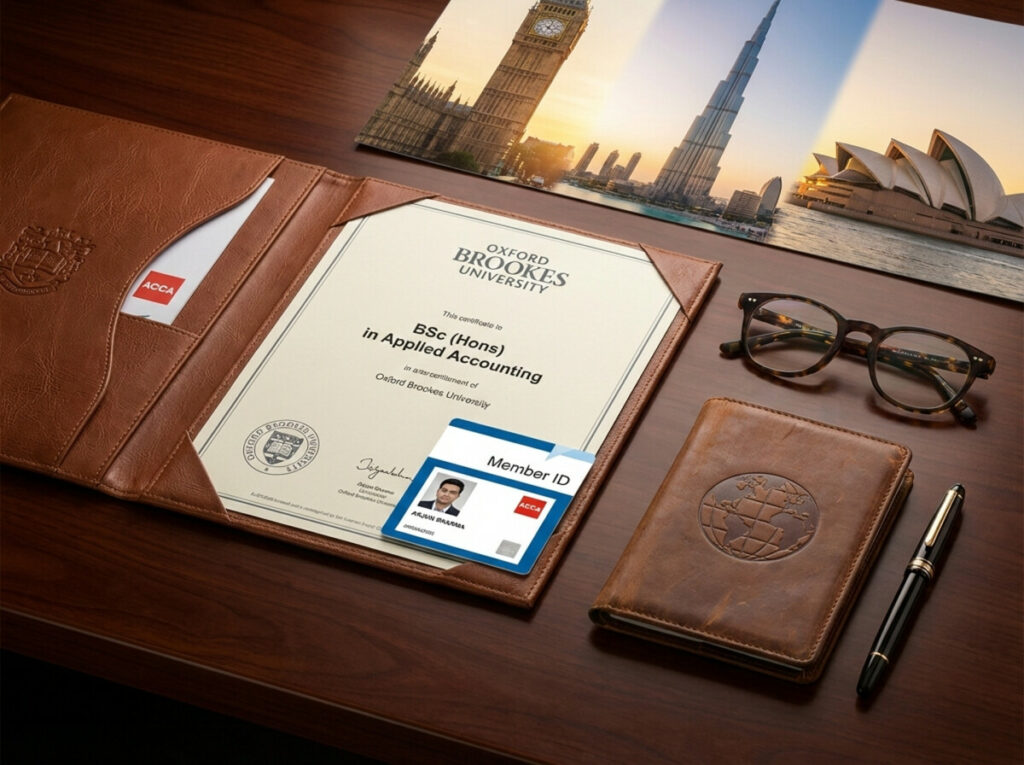
- Oxford Brookes University (OBU): Complete ACCA papers and a research project to earn a BSc (Hons) in Applied Accounting—recognized as a full UK bachelor’s degree for immigration and employment purposes
- University of London: Direct entry into MSc programs
- Global MBA pathways: ACCA members gain advanced standing in international MBA programs
The Oxford Brookes University (OBU) degree path.
Here’s something game-changing most people don’t know about:
While completing ACCA, you can simultaneously earn a Bachelor of Science (Hons) in Applied Accounting from Oxford Brookes University.
How this works:
ACCA papers are recognized as equivalent academic credits toward the OBU degree. As you complete ACCA, you accumulate credit toward the degree. At the end, you submit a Research and Analysis Project (RAP), and boom—you have both:
- ACCA professional membership
- Bachelor’s degree from a UK university
Why this matters for going abroad:
Some countries and employers have formal degree requirements. With OBU degree + ACCA, you have:
- Professional credential (ACCA)
- Academic credential (bachelor’s degree)
This combination is unbeatable in competitive job markets. When applying for roles requiring degrees, you don’t just have ACCA—you have a degree from a respected UK university.
Additional benefits:
- Easier permanent residency applications (some countries prefer degree holders)
- Higher salary negotiation power
- Masters program eligibility (many countries fast-track degree holders)
- Employer preference in many multinationals
Cost: Additional ACCA and OBU fees apply as per Oxford Brookes University and ACCA guidelines.
FAQ’S About ACCA In Nepal
- Is ACCA Recognized in Nepal?
Yes, absolutely. But let me clarify what this means:
ACCA is recognized by:
- Multinational companies as a legitimate professional qualification
- Big 4 firms (actively hire ACCA graduates)
- Employer associations and industry bodies
- International organizations and development agencies
What ACCA is NOT:
- Not regulated by a Nepal government body (it’s an international qualification)
- Cannot sign statutory audit reports alone (that’s ICAN’s exclusive right)
- Not a “Nepali” qualification in the sense that it’s not locally regulated
The practical implication: You can work in any finance role in Nepal with ACCA. You just can’t be the sole signatory on audit reports. If you want that right, you need ICAN too.
- Is ACCA Worth It in Nepal?
Absolutely, ACCA delivers exceptional ROI for Nepali students:
Financial Returns: Net investment of NPR 2,68,500 (after articleship income) leads to starting salaries of NPR 40,000-60,000—full payback within 1-2 years of qualification.
Career Flexibility: Unlike narrow local qualifications, ACCA opens doors to audit, tax, consulting, corporate finance, risk management, and leadership roles—adapting as Nepal’s economy evolves.
Global Safety Net: With political and economic uncertainty, ACCA provides an exit strategy—skills recognized worldwide for migration opportunities.
Professional Prestige: ACCA members are viewed as international professionals, commanding respect in corporate circles and accessing exclusive networking opportunities.
Future-Proof Skills: Curriculum integrates digital finance, AI, sustainability reporting—skills Kathmandu Valley’s expanding tech and financial sectors desperately need.
Alternative Perspective: If your ONLY goal is to own a traditional audit practice in Nepal signing statutory audits, CA alone may be sufficient. For any other ambition, ACCA is superior.
- Can ACCA Sign Audit Reports in Nepal?
Short answer: No, not alone.
Detailed answer:
Nepal’s auditing law reserves the right to sign statutory audit reports exclusively to ICAN Chartered Accountants. This is a legal requirement, not a reflection on ACCA quality.
What this means practically:
- ACCA professionals can work in audit firms and conduct audits
- ACCA professionals can be on audit teams, supervise juniors, review work
- ACCA professionals cannot sign the final audit report as the responsible auditor
- In Big 4 firms, ACCA professionals play key roles in audit execution, reporting, and client engagement, while ICAN members fulfill statutory signing responsibilities.