The ACCA (Association of Chartered Certified Accountants) qualification is widely regarded as the global gold standard in professional accounting. However, with global pass rates for many professional-level papers ranging between 38% and 51%, passing ACCA exams requires far more than hard work alone.
Success depends on a data-driven preparation strategy—one that aligns with examiner expectations, syllabus weightings, and real exam conditions. This ACCA exam guide breaks down exactly how to prepare for and pass ACCA exams on your first attempt, using proven techniques to help you consistently stay within the passing bracket.
Why It’s Important to Pass on the First Attempt
Passing ACCA exams on the first attempt is not just about confidence. It has direct academic, financial, and career consequences.
- Lower total cost:
Every failed attempt means paying exam fees again, additional tuition costs, and extra revision expenses. - Higher living expenses:
Each retake usually adds another 3 months of living costs—rent, food, travel, and daily expenses—significantly increasing the overall cost of qualification. - Shorter qualification timeline:
Multiple failures can delay ACCA completion by 1 to 2 years, postponing job promotions and career growth. - Stronger CV profile:
Employers consistently prefer candidates with first-attempt passes, as it reflects discipline and exam readiness. - Sustained mental momentum:
Repeated failures reduce confidence, increase exam anxiety, and make future papers harder to manage.
ACCA exams are progressive by design. Weak performance at lower levels often results in serious difficulties at Strategic Professional level. Passing early papers efficiently builds the academic discipline and exam technique needed for long-term success.
How to Prepare for ACCA Exams: Level-Specific Strategies
ACCA is structured to test different competencies at each level. Using the same study approach for all papers is one of the biggest mistakes students make.
Level 1: Applied Knowledge (Foundation Papers)
The Applied Knowledge level is your introduction to the global business world. These three papers use On-Demand Computer-Based Exams (CBEs), which are 2 hours long and consist of a mix of Objective Test Questions (OTs) and Multi-Task Questions (MTQs).
Expert Note: While the pass mark is 50%, aiming for 70%+ at this level is crucial because these concepts are directly re-tested in the more difficult Applied Skills papers.
- Business and Technology (BT)
BT focuses on how organizations operate in the real world rather than rote memorization.
- The “2026 Shift”: There is now a significant focus on Digital Technology (AI, Blockchain, and Big Data) and Sustainable Business Practices.
- Examiner Insight: Students often lose “easy marks” in Section B’s Multi-Task Questions (MTQs) by failing to apply the PESTEL or Mendelow’s Matrix correctly to the specific company scenario provided.
- Tip: Treat Ethics questions as “must-win” marks; they are predictable but require a clear understanding of the ACCA Code of Ethics and Conduct.
- Management Accounting (MA)
MA introduces internal numerical concepts, but success depends more on logical understanding than formula memorization.
- Numerical Precision: Because the CBE requires exact number entry, rounding errors are a major cause of failure. Always follow the instruction to “round to the nearest whole number” or “two decimal places.”
- Critical Areas: Regular practice of Standard Costing, Variance Analysis, and CVP (Cost-Volume-Profit) is essential.
- Common Mistake: Many students fail because they spend too much time on a single complex calculation in Section A. Use the 1.2-minute rule—if you can’t solve it in two minutes, flag it and move on.
- Financial Accounting (FA)
FA is the bedrock of the ACCA qualification. It forms the direct foundation for Financial Reporting (FR) and Strategic Business Reporting (SBR).
- Mastering the Mechanics: A flawless grasp of Double-Entry Bookkeeping (Debits and Credits) is non-negotiable.
- Section B Focus: A significant proportion of marks comes from two 15-mark MTQs…, often focusing on Consolidated Financial Statements or the Statement of Cash Flows.
- Common Mistake: Relying on memorized templates. Examiners frequently change the context (e.g., incomplete records), and students who don’t understand the logic of the accounting equation ($Assets = Capital + Liabilities$) often struggle to adjust.
LEVEL 2: APPLIED SKILLS
The Applied Skills level moves beyond foundation knowledge to application and analysis. These exams are Session-Based CBEs, held four times a year (March, June, September, and December). To pass these on your first attempt, you must shift your focus from “what is this?” to “how does this solve the problem in this specific scenario?”
- Corporate and Business Law (LW)
This is the only Skills paper that remains an On-Demand CBE.
- The 2026 Focus: A major update for the 2025/2026 syllabus is the inclusion of “Failure to Prevent Fraud” under corporate criminal behavior. Examiners are increasingly testing corporate responsibility and fraud prevention measures.
- Strategy: Don’t get bogged down in memorizing case names. Focus on the legal principles (e.g., offer vs. invitation to treat in Contract Law). Section B consists of five 6-mark multi-task questions—ensure you practice the “Global” or “English” variant specific to your registration.
- Performance Management (PM)
Historically one of the most difficult Skills papers, with pass rates often dipping to 40-43%.
- Deep Fact: The 2026 syllabus now explicitly includes volatility and uncertainty in budgeting systems (incremental, flexed, and rolling budgets).
- Strategy: You must master the “spreadsheet” functionality. Students often fail PM not because of math, but because they can’t explain why a variance occurred. 40% of the marks are narrative—practice writing clear, concise explanations for your calculations.
- Taxation (TX)
Taxation is highly rule-based and updated annually for the Finance Act 2024 (FA24) in the current cycle.
- Key Changes: Focus on the new National Insurance Contribution (NIC) rates and the enhanced 100% first-year allowances for asset purchases.
- Strategy: Section C typically features a large Income Tax or Corporation Tax computation. Create a “Pro-forma” cheat sheet for yourself to ensure you never miss easy marks like personal allowances or capital allowance thresholds.
- Financial Reporting (FR)
FR builds directly on your FA knowledge but introduces complex group structures.
- The IFRS 18 Revolution: Starting September 2025, IFRS 18 replaces IAS 1. This significantly changes how the Statement of Profit or Loss is presented (new sub-totals like “Operating Profit”).
- Strategy: Practice Consolidated Statements of Cash Flows. This is a frequent area of failure. Ensure you understand the “Conceptual Framework”—if you can explain the theory, you can handle any “twist” the examiner throws at you.
- Audit and Assurance (AA)
This paper has a “reputation” because it requires a specific mindset: Professional Skepticism.
- 2026 Update: New emphasis on Quality Management Procedures (formerly Quality Control). You will be tested on evaluating deficiencies in audit quality and recommending improvements.
- Strategy: Use the “Identify, Explain, and Recommendation” format for Internal Control questions. For Audit Risks, always link the risk to the relevant Financial Statement Assertion (e.g., Existence, Valuation, or Completeness).
- Financial Management (FM)
FM prepares you for the role of a CFO. It covers raising finance, investment appraisal, and risk management.
- The “Section C” Guarantee: 40 marks almost always come from Working Capital Management, Investment Appraisal (NPV/IRR), and Business Finance.
- Strategy: In NPV calculations, pay close attention to tax-allowable depreciation and inflation rates applied to sales vs. costs. Examiners report that students who show clear workings (even with a wrong final answer) often pass, while those with no workings fail.
Strategic Professional Level (6 Papers)
At this final stage, you transition from being a student to a Professional Consultant. The focus shifts from technical calculation to high-level advisory and leadership.
Mandatory Papers (2)
- Strategic Business Leader (SBL)
SBL is an integrated case study that simulates a real-world board-level environment.
- The 2026 Format: The exam is now 3 hours and 15 minutes long. You receive Pre-seen material two weeks before the exam.
- Deep Fact: You cannot “study” for SBL in the traditional sense; you must analyze the Pre-seen to understand the industry context (e.g., if the scenario is a robotics firm, you must understand its supply chain).
- Winning Strategy: All 5 professional skills are tested once each, worth 4 marks. Focus on Commercial Acumen—making recommendations that are financially viable and ethically sound for that specific company.
- Strategic Business Reporting (SBR)
This is the advanced version of Financial Reporting.
- The IFRS 18 Update: Starting in the 2025/2026 cycle, SBR heavily tests the new IFRS 18 standards regarding the “Presentation and Disclosure” of financial statements.
- Deep Fact: 2026 exams now include a new learning outcome to examine the differences between IFRS Sustainability Disclosure Standards and European Sustainability Reporting Standards (ESRS).
- Winning Strategy: Do not just calculate; you must explain the accounting treatment to a stakeholder who may not be an accountant. Narrative explanation is 75% of the mark.
The Optional Papers (Choose 2 of 4)
Choosing the right options is a career-defining move. We recommend aligning these with your long-term goals at CCA College.
| Paper | Who should choose it? | Core Challenge |
| Advanced Financial Management (AFM) | Future CFOs, Investment Bankers, or Treasury Managers. | Complex hedging (Forex/Interest) and Business Valuations. |
| Advanced Performance Management (APM) | Business Strategists and Management Consultants. | Highly subjective; requires deep analysis of KPIs beyond just numbers. |
| Advanced Taxation (ATX) | Tax Consultants and Private Practitioners. | Massive syllabus requires remembering intricate rules and anti-avoidance laws. |
| Advanced Audit & Assurance (AAA) | Aspiring Audit Partners and Compliance Officers. | Lowest pass rate (~38%); requires extreme Professional Skepticism. |
Strategic ACCA Exam Tips for a First-Attempt Pass
Passing ACCA exams on the first attempt depends less on how much you study and more on how you manage the exam environment. 2025 Examiner Reports consistently show that most failures (especially at the 47–49 mark range) occur due to poor time control, weak question interpretation, and underuse of Professional Skills Marks (PSM).
- The 1.8-Minute Rule
The standard formula for most ACCA papers is 1.8 minutes per mark ($180 \text{ minutes} \div 100 \text{ marks}$). However, for Strategic Professional (SP) papers, the math changes to account for the 20 Professional Skills Marks earned simultaneously with technical points.
- SBL Strategy: You have 240 minutes. Experts recommend 40 minutes for reading/planning and 2.5 minutes per technical mark for writing.
- Applied Skills Strategy: Stick to 1.8 minutes per mark. Spend no more than 36 minutes on a 20-mark constructive response question.
- The “Scoring, Not Perfecting” Goal: Examiners note that students who fail often spend 50% of their time on the first 30% of the paper. Discipline is the key: Once your allocated time for a question is up, move on. An incomplete but broad answer usually scores higher than a “perfect” but half-finished one.
- Decoding “Verb” Requirements:
Every ACCA question contains command verbs that clearly signal how marks are awarded. Ignoring these verbs is one of the most common reasons students lose easy marks.
Words such as list, describe, explain, analyze, evaluate, and discuss each require a different depth of response. For example, list requires brief bullet points, while evaluate demands balanced arguments and a clear conclusion.
Many students fail not because they lack knowledge, but because they answer the wrong question. Matching your answer style precisely to the command verb significantly improves scoring efficiency.
- Professional Skills Marks:
In the Strategic Professional level, 20 out of 100 marks are awarded for how you present your answer. In 2025, the pass rate for students who completed the Ethics and Professional Skills Module (EPSM) was 25% higher than those who didn’t.
- Communication: Use the correct format (Memo, Report, Presentation slides).
- Skepticism: Don’t take the scenario’s data at face value. Question the assumptions or look for missing information.
- Commercial Acumen: Show you understand the “real-world” business context. If the scenario is an airline, talk about fuel costs or global travel trends.
- Format Matters: Use clear headings and white space. A wall of text makes it difficult for markers to award points.
Why Students Fail: Lessons from the Examiner’s Reports
To pass on your first attempt, you must look beyond the textbook and understand the mindset of the marker. The Examiner’s Reports highlighted three “Silent Killers” of exam success:
- Ignoring the “Pre-seen” (SBL): Students often bring generic knowledge rather than applying it to the specific industry provided in the pre-seen material.
- CBE Technical Struggles: Many students lose 10–15 minutes simply struggling with the spreadsheet’s “Response Option” tool. Practice the official ACCA Practice Platform early.
- Answering the “Wrong” Question: Students often answer the question they wished was asked rather than the one on the screen.
At CCA College, we don’t just teach the syllabus; we teach the Exam Technique. As a Platinum Approved Learning Partner, we have developed specific strategies to help you navigate these “Silent Killers” with ease.
ACCA Pass Rates & Difficulty Ranking
Understanding the global pass rates is a benchmarking tool. It helps you identify “high-risk” papers so you can allocate more study hours where they are needed most.
| ACCA Level | Papers | Global Pass Rate (Avg) | Perceived Difficulty | Why Students Find It Difficult |
| Applied Knowledge | BT, MA, FA | 64% – 87% | Low | Foundation concepts with objective questions. Difficulty is low if basic double-entry and cost logic are clear. |
| Applied Skills | LW, TX, FR, AA, PM, FM | 40% – 55% | Medium to High | Significant shift from theory to application. Success requires managing the CBE spreadsheet and written “Constructed Response” sections. |
| Strategic Professional | SBL, SBR, AFM, APM, ATX, AAA | 38% – 51% | Highest | Heavy focus on professional skepticism, 20 professional marks, and advising a board of directors rather than just “doing the math.” |
Difficulty Ranking by Student Experience
| Difficulty Rank | ACCA Papers | Primary Reason for Failure |
| Tier 1: Most Difficult | AAA, PM, SBR | AAA (38%) is the toughest due to the audit judgment required. PM (40%) is the “Skills trap” where students struggle with data interpretation. |
| Tier 2: Moderately Difficult | AFM, FR, AA, FM | These are technical “heavyweights.” FR (51%) and AA (46%) require high-speed calculation and specific audit risk identification. |
| Tier 3: Less Difficult | BT, LW, FA | Predictable patterns and higher objective-test portions. BT (87%) and LW (82%) remain the most accessible papers. |
Why CCA Students Succeed
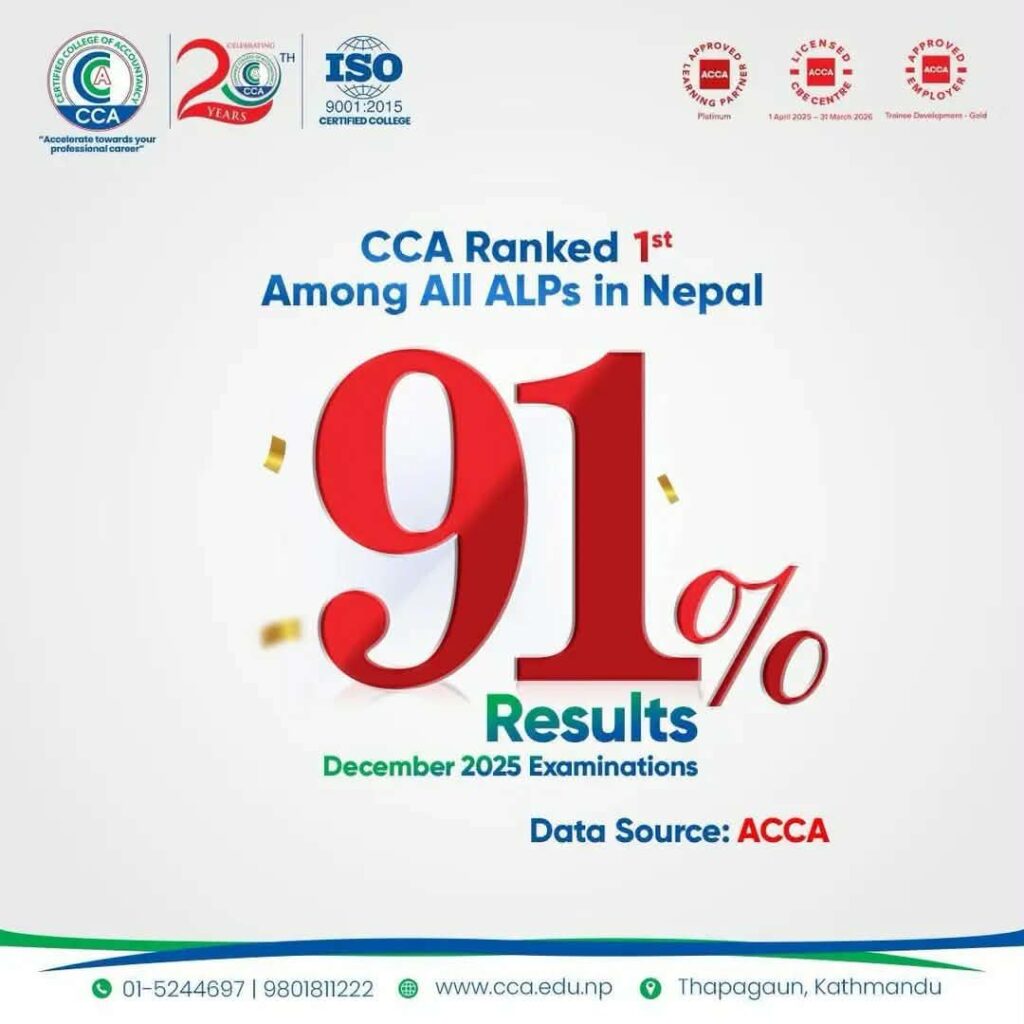
CCA students succeed because their preparation is meticulously structured, disciplined, and strictly aligned with ACCA global examiner expectations. Rather than relying on static textbook theory, our learners follow dynamic study plans that prioritize deep conceptual clarity, aggressive question-drilling, and strategic revision cycles.
At CCA, teaching is inherently exam-focused; we don’t just deliver content, we deconstruct marking schemes, analyze examiner reports, and perfect answer structures. By conducting regular mock exams in our Licensed CBE (Computer-Based Exam) environment, we help students build the “exam-room stamina” needed to master the 1.8-minute rule and significantly reduce exam-day anxiety.
Most importantly, CCA is the only college in Nepal to utilize a Dual Faculty System, ensuring students apply knowledge professionally by developing high-level judgment and communication skills. This holistic approach is why CCA consistently produces World and National Rank Holders, maintaining first-attempt pass rates that often reach 85% to 100%, far exceeding global averages.
Frequently Asked Questions
- How many hours should I study for ACCA on average?
For a “comfortable pass,” aim for 130–150 hours per paper. This typically breaks down to 10–12 hours of weekly study over a 3-month session.
- Knowledge Level: 100–120 hours.
- Skills Level: 120–150 hours.
- Professional Level: 150–200 hours (due to heavy reading and case study analysis).
- What is the hardest ACCA exam to pass?
Statistically, Advanced Audit and Assurance (AAA) is the toughest, with global pass rates often dipping to 38%. At the Skills level, Performance Management (PM) is considered the most challenging “barrier” paper due to its complex data interpretation requirements.
- Is self-study enough to pass ACCA in the first attempt?
While possible for Knowledge papers, self-study becomes risky at the Skills and Professional levels. Platinum Learning Partners like CCA provide the “examiner’s perspective” and personalized feedback that self-study lacks, which is often the difference between a 48% fail and a 52% pass.
- How important are past papers?
They are your most critical tool. You should never enter an exam hall without completing at least 3–5 recent past papers under timed conditions. Using the official ACCA Practice Platform is essential to get used to the digital spreadsheet and word processing tools you will use on exam day.
- How to handle ACCA exam stress?
Managing ACCA exam stress is best achieved through tactical discipline and environmental familiarity. The primary source of anxiety for most students is the fear of an incomplete paper, which can be neutralized by strictly adhering to the 1.8-minute rule—limiting your time to exactly 1.8 minutes per mark to ensure every section is attempted.
By staying present and focusing only on the specific requirement in front of you rather than the final grade, you can remain calm and allow your professional training to lead you to a first-time pass.
- What happens if I fail an ACCA exam?
Failing is a setback, not the end. You can retake the exam in the next quarterly session.
- Analyze: Use the “My Exam Performance” tool on your myACCA portal to see exactly where you lost marks.
- Re-group: At CCA, we help failing students identify “knowledge gaps” versus “technique gaps” to ensure the second attempt is a guaranteed success.