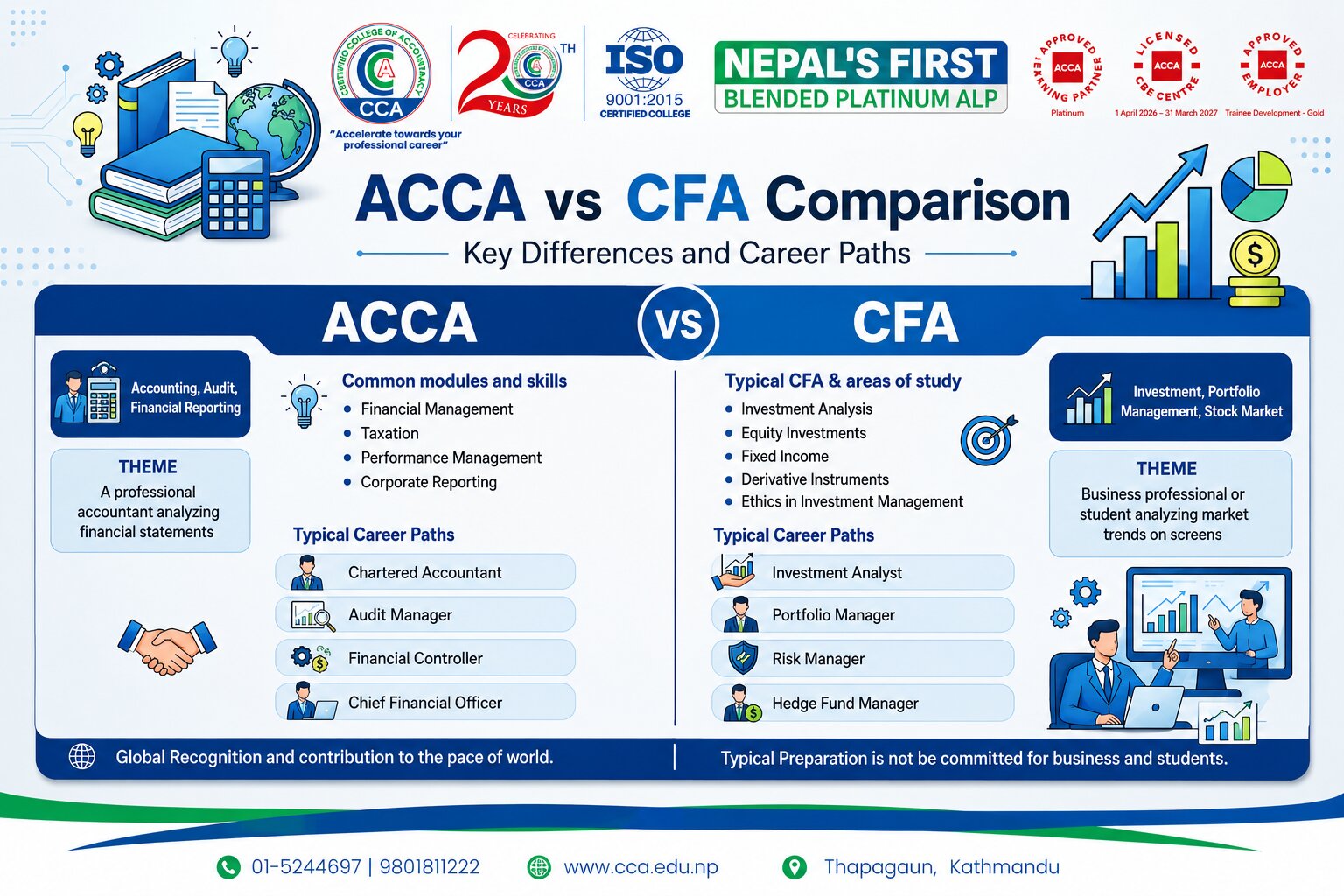
Choosing between ACCA vs CFA can be challenging because both qualifications are highly respected in the finance industry. However, they are designed for different career paths.
If you’re interested in accounting, auditing, taxation, financial reporting, or corporate finance, ACCA is generally the better option. On the other hand, if your goal is investment banking, portfolio management, equity research, or asset management, CFA is a more suitable choice.
The best qualification depends on your career goals, interests, and the type of finance role you want to pursue.
What Is ACCA?
The Association of Chartered Certified Accountants (ACCA) is a globally recognized professional accounting qualification. It prepares students for careers in accounting, auditing, taxation, financial management, and business leadership.
The ACCA qualification combines technical accounting knowledge with practical business and management skills. Students learn topics such as financial reporting, taxation, audit and assurance, performance management, corporate law, and strategic business leadership.
To become an ACCA member, candidates typically complete:
- Up to 13 exams (depending on exemptions)
- An Ethics and Professional Skills Module
- 36 months of relevant practical experience
ACCA members work in public practice, multinational companies, banks, consulting firms, government organizations, and non-profit organizations across more than 180 countries.
Best suited for:
- Accounting
- Auditing
- Taxation
- Financial reporting
- Corporate finance
- Management accounting
What Is CFA?
The Chartered Financial Analyst (CFA) designation is one of the world’s most respected qualifications in investment management and financial analysis. It is awarded by the CFA Institute and focuses on investment decision-making and portfolio management.
Unlike ACCA, CFA specializes in capital markets and investment-related careers. The curriculum emphasizes financial analysis, economics, ethics, portfolio management, fixed income, derivatives, alternative investments, and equity valuation.
To earn the CFA charter, candidates must:
- Pass three exam levels
- Meet work experience requirements
- Become a CFA Institute member
The CFA program is widely recognized by investment firms, banks, hedge funds, and asset management companies worldwide.
Best suited for:
- Investment banking
- Equity research
- Portfolio management
- Wealth management
- Asset management
- Financial analysis
ACCA vs CFA: Comparison
| Criteria | ACCA | CFA |
| Focus | Accounting, auditing, taxation, finance | Investment management and financial analysis |
| Best For | Future accountants and finance professionals | Investment and portfolio management professionals |
| Duration | Around 2–3 years | Around 3–4 years |
| Exams | Up to 13 papers (depending on exemptions) | 3 exam levels |
| Eligibility | High school or bachelor’s degree pathway | Bachelor’s degree or equivalent eligibility requirements |
| Difficulty | Challenging but manageable with consistent study | Considered one of the toughest finance qualifications |
| Global Recognition | Recognized in 180+ countries | Highly respected worldwide, especially in investment finance |
| Career Paths | Audit, accounting, tax, corporate finance | Investment banking, equity research, asset management |
| Salary Potential | Competitive across many industries | Often higher in investment-focused roles |
| Cost | Moderate | Generally higher than ACCA |
Difference Between ACCA and CFA
Although both qualifications open doors to rewarding careers in finance, their focus, curriculum, and career outcomes are quite different.
Course Focus
The biggest difference between ACCA and CFA is their area of specialization.
ACCA focuses on accounting and business finance. It develops expertise in financial reporting, auditing, taxation, corporate governance, and management accounting.
CFA focuses on investments and financial markets. It prepares professionals to analyze investments, manage portfolios, value companies, and make informed investment decisions.
If you enjoy preparing financial statements and ensuring compliance, ACCA is likely the better fit. If you’re interested in stock markets, investments, and financial analysis, CFA aligns more closely with those goals.
Curriculum
The ACCA syllabus covers a broad range of accounting and business topics, including:
- Financial Accounting
- Financial Reporting
- Audit and Assurance
- Taxation
- Corporate Law
- Performance Management
- Financial Management
- Strategic Business Leadership
This broad curriculum prepares graduates for finance roles across many industries.
The CFA curriculum is more specialized and includes subjects such as:
- Ethics and Professional Standards
- Quantitative Methods
- Economics
- Financial Statement Analysis
- Equity Investments
- Fixed Income
- Derivatives
- Alternative Investments
- Portfolio Management
Its strong emphasis on investment analysis makes CFA particularly valuable for careers in capital markets.
Exam Structure
The ACCA qualification consists of up to 13 exams divided into three levels:
- Applied Knowledge
- Applied Skills
- Strategic Professional
Some students may receive exemptions based on previous academic qualifications.
The CFA Program has three sequential exam levels:
- Level I – Investment tools and basic concepts
- Level II – Asset valuation and financial analysis
- Level III – Portfolio management and wealth planning
Candidates must pass each level before progressing to the next.
Duration
The time required to complete each qualification depends on your study schedule and exam success.
Most students complete ACCA in around 2 to 3 years, especially if they receive exemptions and study consistently.
The CFA Program generally takes 3 to 4 years to complete because candidates must pass three levels in sequence and exam schedules limit how quickly they can progress.
Eligibility
ACCA offers flexible entry routes, making it accessible to students after high school as well as university graduates. Depending on your educational background, you may also qualify for exemptions from certain exams.
For the CFA Program, candidates typically need a bachelor’s degree or to meet the CFA Institute’s eligibility requirements based on education or professional experience before registering for the exams.
Students should always check the latest eligibility criteria on the official ACCA and CFA Institute websites before applying.
Skills You Develop
Both qualifications build valuable professional skills, but the focus differs.
With ACCA, you’ll develop skills in:
- Financial reporting
- Auditing
- Tax planning
- Budgeting
- Business strategy
- Risk management
- Corporate finance
These skills prepare you for leadership roles in accounting and finance departments.
With CFA, you’ll strengthen your abilities in:
- Investment analysis
- Financial modelling
- Equity valuation
- Portfolio construction
- Risk analysis
- Asset allocation
- Capital market research
These skills are highly sought after by investment firms and financial institutions.
ACCA vs CFA Career Opportunities
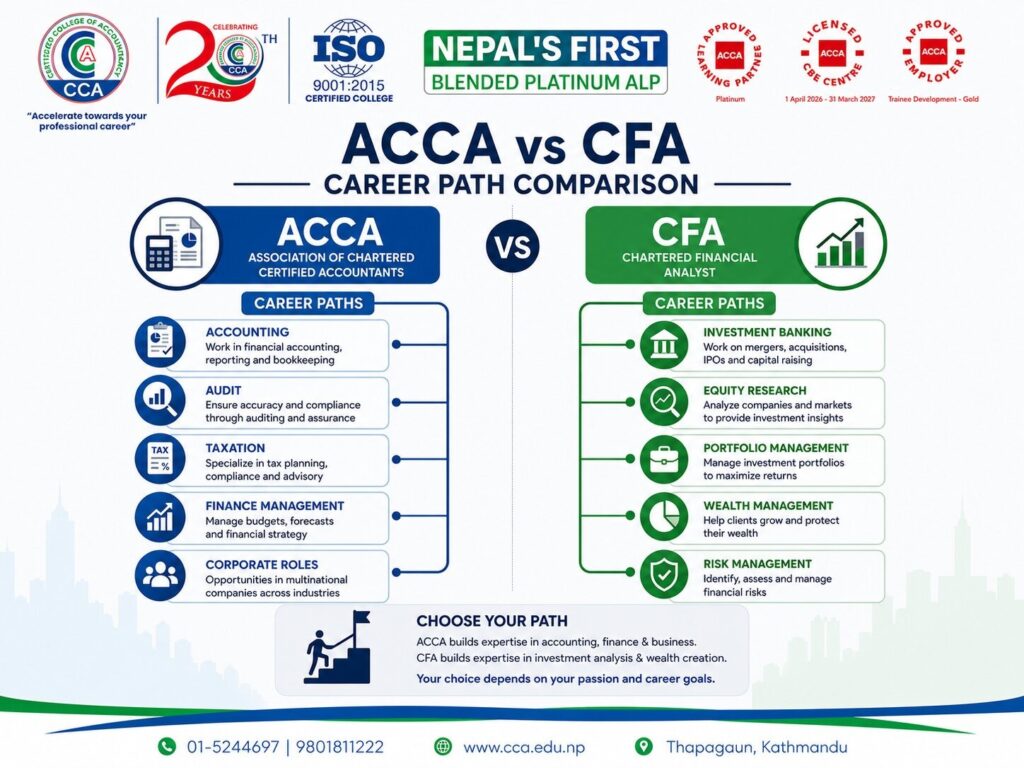
Both ACCA and CFA open doors to rewarding careers, but they prepare professionals for different areas of finance.
Careers After ACCA
An ACCA qualification prepares you for accounting, finance, and business leadership roles. Popular career options include:
- Accountant
- Auditor
- Tax Consultant
- Financial Analyst
- Management Accountant
- Finance Manager
- Internal Auditor
- Financial Controller
- Chief Financial Officer (CFO)
Since ACCA covers accounting, taxation, auditing, and financial management, professionals can work across various industries.
Industries Hiring ACCA Professionals
ACCA-qualified professionals are in demand in:
- Accounting and audit firms
- Banks and financial institutions
- Insurance companies
- Manufacturing companies
- Technology companies
- Government organizations
- NGOs and INGOs
- Multinational corporations (MNCs)
The broad nature of the ACCA qualification makes it suitable for professionals who want flexibility in their careers.
Careers After CFA
The CFA designation is ideal for professionals interested in investments and financial markets. Common job roles include:
- Investment Analyst
- Equity Research Analyst
- Portfolio Manager
- Wealth Manager
- Asset Manager
- Investment Banker
- Risk Analyst
- Fund Manager
These roles focus on evaluating investments, managing portfolios, and helping clients make informed financial decisions.
Industries Hiring CFA Professionals
CFA charterholders are commonly employed by:
- Investment banks
- Asset management companies
- Mutual funds
- Hedge funds
- Private equity firms
- Stock brokerage firms
- Wealth management companies
- Investment advisory firms
If your career goal is to work in the capital markets or investment industry, CFA is generally the better choice.
ACCA vs CFA Salary
One of the biggest factors students consider is salary. However, there is no fixed salary for either qualification because earnings depend on several factors.
Generally:
- ACCA professionals earn competitive salaries in accounting, auditing, taxation, and corporate finance roles.
- CFA professionals often have higher earning potential in investment banking, portfolio management, and asset management, particularly when bonuses are included.
Factors That Affect Salary
Your salary depends on:
- Years of experience
- Country of employment
- Industry
- Employer
- Technical skills
- Leadership responsibilities
Rather than choosing a qualification based only on salary, focus on the career path that best matches your interests and strengths.
CFA vs ACCA Cost: Fee Breakdown
The total cost of ACCA and CFA varies depending on registration, exams, and study materials.
ACCA Costs
Typical ACCA expenses include:
- Initial registration fee
- Annual subscription fee
- Exam fees
- Ethics and Professional Skills Module fee
- Tuition or coaching fees (optional)
Students who receive exemptions may complete the qualification at a lower overall cost.
CFA Costs
The CFA Program generally includes:
- Enrollment fee
- Registration fee for each exam level
- Optional study materials and preparation courses
Overall, the CFA Program is usually more expensive than ACCA because of higher exam fees and study costs.
Note: Fees are updated regularly, so always check the official ACCA and CFA Institute websites for the latest pricing.
ACCA vs CFA: Which Is More Difficult?
Both qualifications are challenging, but they test different skills.
Why ACCA Is Challenging
- Up to 13 exams
- Technical accounting standards
- Audit and taxation concepts
- Practical application of accounting knowledge
Why CFA Is Challenging
- Three highly rigorous exam levels
- Strong emphasis on quantitative analysis
- Advanced investment concepts
- Historically lower pass rates than many professional qualifications
Which Is Harder?
Many professionals consider CFA more difficult because of its demanding curriculum and intensive exam preparation. However, ACCA is also challenging due to the number of exams and the depth of accounting knowledge required.
The easier qualification is ultimately the one that aligns with your interests and academic strengths.
ACCA vs CFA: Which Is Better?
There is no one-size-fits-all answer. The right qualification depends on your career goals.
Choose ACCA If You:
- Enjoy accounting and financial reporting
- Want to work in auditing or taxation
- Plan to build a career in corporate finance
- Want opportunities across different industries
- Aim for leadership roles such as Finance Manager or CFO
Choose CFA If You:
- Are passionate about investing and financial markets
- Want to become an investment analyst
- Enjoy company valuation and financial modelling
- Plan to work in asset or wealth management
- Aspire to a career in investment banking
Can You Pursue Both?
Yes. Many professionals complete ACCA first and later pursue CFA to specialize in investment management. Having both qualifications can broaden your career opportunities, especially in corporate finance and investment-related roles.
ACCA vs CFA in Nepal
Both ACCA and CFA are recognized in Nepal, but their career opportunities differ.
Scope of ACCA in Nepal
ACCA professionals are employed in:
- Audit firms
- Commercial banks
- Insurance companies
- Consulting firms
- Manufacturing companies
- NGOs and INGOs
- Multinational companies
Because every organization needs accounting and financial management, ACCA offers broad employment opportunities in Nepal.
Scope of CFA in Nepal
CFA professionals are mainly hired by:
- Merchant banks
- Investment companies
- Mutual funds
- Stock brokerage firms
- Asset management companies
- Investment advisory firms
As Nepal’s capital market continues to grow, the demand for CFA-qualified professionals is also increasing.
Which Has Better Scope in Nepal?
If you want a wider range of accounting and finance careers, ACCA is generally the better option. If your goal is to work in investments, portfolio management, or the stock market, CFA is the more suitable qualification.
Conclusion
Choosing between ACCA vs CFA comes down to your career aspirations.
If you want a career in accounting, auditing, taxation, or corporate finance, ACCA provides a broad and globally recognized qualification with opportunities across many industries.
If you’re interested in investment banking, financial analysis, asset management, or portfolio management, CFA offers specialized knowledge that is highly valued in the investment sector.
Neither qualification is better than the other—they simply serve different purposes. Before making your decision, consider your interests, strengths, and long-term career goals.
FAQs About ACCA vs CFA
1. Is ACCA harder than CFA?
Most professionals consider CFA more challenging due to its rigorous curriculum, analytical focus, and historically lower pass rates. However, ACCA is also demanding because of its comprehensive accounting syllabus.
2. What pays more, CFA or ACCA?
CFA professionals often have higher earning potential in investment-focused careers. However, experienced ACCA professionals in senior finance roles can also earn highly competitive salaries.
3. Is ACCA equivalent to CFA?
No. ACCA is an accounting qualification, while CFA is an investment management qualification. They are designed for different career paths.
4. Is CFA worth it after ACCA?
Yes. If you want to transition from accounting into investment analysis, portfolio management, or asset management, pursuing CFA after ACCA can enhance your expertise and career opportunities.