
Many students believe ACCA only leads to careers in accounting or auditing. In reality, the qualification opens doors to a wide range of finance roles across industries, including banking, corporate finance, financial analysis, risk management, and business consulting.
If you’re wondering whether you can build a career in finance with ACCA, the answer is yes. ACCA equips you with technical finance knowledge, business understanding, and practical skills that employers value in today’s competitive job market.
Whether you’re planning to become a Financial Analyst, Finance Manager, Corporate Finance Executive, or Risk Analyst, ACCA provides a solid foundation for long-term career growth. Combined with practical experience and in-demand skills like financial modelling and Excel, it can help you pursue rewarding opportunities in both Nepal and internationally.
Can You Build a Career in Finance with ACCA?
Yes, you can build a successful career in finance with ACCA. Although the qualification is best known for accounting, its syllabus covers many finance-focused topics that prepare students for roles beyond traditional accounting.
Throughout the ACCA program, you’ll study areas such as financial management, performance management, financial reporting, strategic business leadership, taxation, auditing, and corporate governance. These subjects help you understand how businesses make financial decisions, manage risk, evaluate investments, and improve performance.
As a result, ACCA professionals work in various finance functions, including:
- Financial Analysis
- Corporate Finance
- Management Accounting
- Financial Planning & Analysis (FP&A)
- Treasury
- Risk Management
- Financial Reporting
- Business Consulting
- Banking and Financial Services
Since finance professionals are needed in almost every industry, ACCA graduates can find opportunities in multinational companies, banks, consulting firms, manufacturing companies, technology businesses, healthcare organizations, NGOs, and government institutions.
The qualification also includes a Practical Experience Requirement (PER), allowing students to gain real-world experience alongside their studies. This combination of technical knowledge and workplace experience makes ACCA graduates attractive to employers.
Is ACCA Only for Accountants?
No. This is one of the biggest misconceptions about ACCA.
While many ACCA members work in accounting and auditing, the qualification is designed to develop broader business and finance expertise. Its curriculum focuses on understanding how organizations manage finances, make strategic decisions, control costs, assess risks, and achieve sustainable growth.
For example, ACCA students learn to:
- Analyze financial statements
- Prepare budgets and forecasts
- Evaluate investment opportunities
- Manage business risks
- Improve financial performance
- Support strategic business decisions
These skills are highly relevant across many finance roles—not just accounting.
As professionals gain experience, many move into positions such as Finance Manager, Financial Controller, Commercial Finance Manager, Risk Analyst, or Corporate Finance Executive. Some also pursue leadership roles like Head of Finance or Chief Financial Officer (CFO) after building significant industry experience.
In short, ACCA provides flexibility. It allows you to start in accounting if you choose, but it also offers a pathway into broader finance and business leadership careers.
Can I Work in Finance with ACCA?
Absolutely. ACCA is widely recognized by employers looking for professionals with strong financial and business knowledge.
The qualification develops practical skills that are directly applicable to finance roles, including:
- Financial analysis
- Budgeting and forecasting
- Financial reporting
- Cost management
- Business performance analysis
- Risk assessment
- Corporate finance
- Decision-making based on financial data
These capabilities are valuable in departments responsible for planning, investment decisions, budgeting, and financial strategy.
Many employers hire ACCA students and members for finance positions because they understand international financial reporting standards (IFRS), financial management principles, and business strategy. Employers also value the ethics and professionalism emphasized throughout the ACCA qualification.
If your goal is to work in finance rather than only accounting, ACCA can provide a strong starting point. Building complementary skills such as advanced Excel, financial modelling, Power BI, and data analysis can further improve your career prospects.
Why ACCA Is a Strong Qualification for Finance Careers
Finance employers look for professionals who can interpret financial data, support business decisions, manage risks, and contribute to long-term growth. ACCA develops these competencies through a globally recognized curriculum that combines technical knowledge with practical business skills.
Here’s why ACCA is considered a strong qualification for finance careers.
Global Recognition
ACCA is recognized by employers in more than 180 countries, making it one of the world’s leading professional accounting and finance qualifications.
Its international recognition creates opportunities to work across different industries and countries, particularly with multinational companies that follow global financial reporting standards.
Because ACCA follows internationally accepted accounting and finance principles, employers know that qualified professionals have a consistent level of technical knowledge and ethical standards.
Industry-Relevant Finance Knowledge
The ACCA syllabus goes beyond bookkeeping and accounting. It covers many areas that are essential for modern finance professionals.
Students develop knowledge in areas such as:
- Financial Management
- Performance Management
- Strategic Business Leadership
- Financial Reporting
- Corporate Governance
- Business Strategy
- Risk Management
- Investment Appraisal
- Working Capital Management
These topics prepare graduates to analyze business performance, support investment decisions, manage financial resources, and contribute to strategic planning.
This broad knowledge base allows ACCA professionals to pursue careers in corporate finance, financial analysis, management accounting, treasury, and other finance-related fields.
Practical Skills Employers Value
Technical knowledge alone is not enough for a successful finance career. Employers also seek professionals who can apply that knowledge in real business situations.
ACCA emphasizes practical learning through its Practical Experience Requirement (PER) and Ethics and Professional Skills Module. Together, they help students develop workplace-ready skills such as:
- Financial analysis and reporting
- Budget preparation
- Business decision-making
- Problem-solving
- Professional communication
- Leadership
- Ethical judgment
- Commercial awareness
These practical skills make ACCA graduates well-prepared to handle the challenges of modern finance roles and contribute effectively from the beginning of their careers.
Best Finance Career Options After ACCA
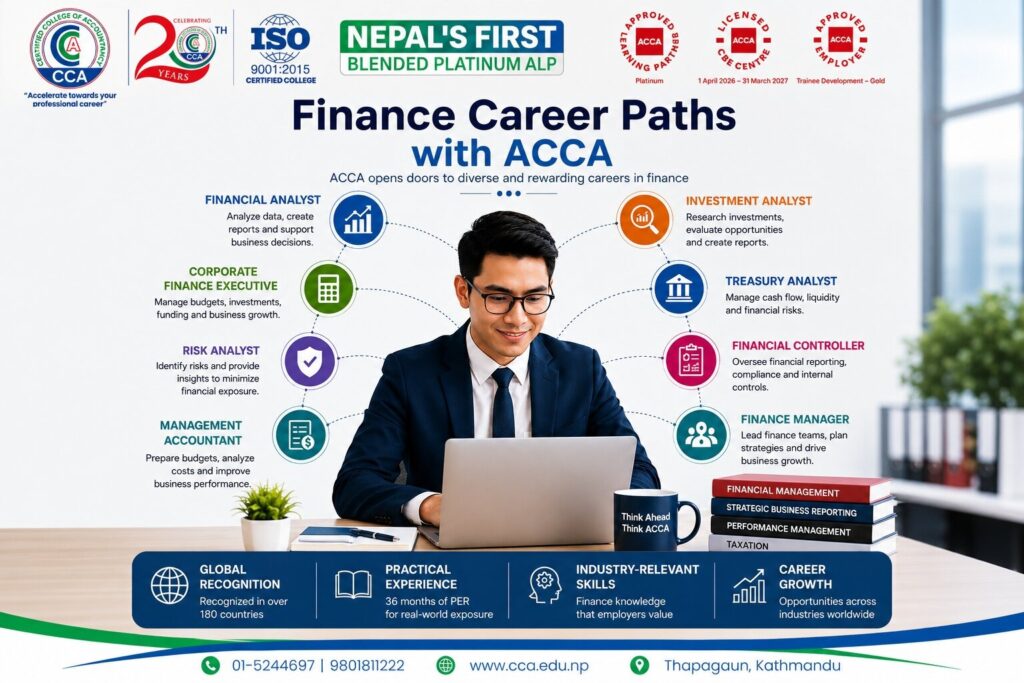
ACCA prepares you for a variety of finance roles across industries. While some positions may require additional experience or specialized skills, the qualification provides a strong foundation for each of these career paths.
| Job Role | What They Do | Suitable After ACCA |
| Financial Analyst | Analyze financial data, prepare forecasts, and support business decisions. | ✅ Yes |
| Corporate Finance Executive | Manage budgeting, investments, funding, and business growth projects. | ✅ Yes |
| Investment Analyst | Research companies, evaluate investments, and prepare financial reports. Additional certifications may be helpful for investment-focused roles. | ✅ Yes |
| Treasury Analyst | Manage cash flow, liquidity, and financial risk. | ✅ Yes |
| Financial Controller | Oversee financial reporting, compliance, and internal controls. | ✅ Yes (with experience) |
| Risk Analyst | Identify financial and operational risks and recommend solutions. | ✅ Yes |
| Audit & Assurance Professional | Conduct audits, ensure compliance, and improve internal controls. | ✅ Yes |
| Tax Consultant | Provide tax planning, compliance, and advisory services. | ✅ Yes |
| Management Accountant | Prepare budgets, analyze costs, and support business planning. | ✅ Yes |
| Finance Manager | Lead financial planning, reporting, and team management. | ✅ Yes (with experience) |
These roles are available in industries such as banking, financial services, manufacturing, technology, healthcare, consulting, retail, and multinational companies.
Skills Needed to Succeed in a Finance Career with ACCA
Passing ACCA exams is only part of the journey. Employers also look for technical and professional skills that help you perform effectively in finance roles.
Technical Skills
Develop these skills alongside your ACCA studies:
- Financial analysis
- Advanced Excel
- Financial modelling
- Budgeting and forecasting
- Financial reporting
- IFRS knowledge
Learning tools like Power BI, Tableau, or SAP can further improve your employability.
Soft Skills
Finance professionals regularly work with managers, clients, and stakeholders, making soft skills equally important.
Focus on improving:
- Communication
- Critical thinking
- Problem-solving
- Leadership
- Time management
- Business understanding
A combination of ACCA knowledge, practical experience, and these skills will help you stand out in today’s competitive finance job market.
How to Start Your Finance Career with ACCA
Building a successful career in finance with ACCA requires more than passing exams. Follow these steps to improve your job prospects:
- Complete the ACCA qualification and build a strong understanding of finance, reporting, and business management.
- Gain practical experience through internships, entry-level finance roles, or ACCA’s Practical Experience Requirement (PER).
- Develop technical skills such as Advanced Excel, financial modelling, budgeting, and IFRS.
- Build a professional network by connecting with finance professionals and attending industry events.
- Apply for entry-level finance roles like Financial Analyst, Management Accountant, Audit Associate, or Corporate Finance Executive.
- Continue learning through certifications, workshops, and hands-on experience to grow into senior finance positions.
Starting early and continuously improving your skills will help you build a rewarding finance career.
Is ACCA the Right Choice for Your Finance Career?
If you want a career in financial analysis, corporate finance, management accounting, auditing, or financial leadership, ACCA is an excellent choice.
The qualification combines technical finance knowledge with practical business skills, making it valuable across many industries. It is also globally recognized, giving you opportunities to work with multinational companies and pursue international careers.
However, your long-term success will also depend on gaining relevant work experience, developing technical skills, and staying updated with industry trends.
Conclusion
If you’re wondering whether you can build a career in finance with ACCA, the answer is yes. ACCA is much more than an accounting qualification—it equips you with the knowledge and skills needed for a wide range of finance roles.
From Financial Analyst and Corporate Finance Executive to Finance Manager and Risk Analyst, ACCA opens doors across banking, consulting, manufacturing, technology, and many other industries.
To maximize your opportunities, combine your ACCA qualification with practical experience, strong analytical skills, and proficiency in tools like Excel and financial modelling. With the right approach, ACCA can be the foundation of a successful and rewarding finance career.
FAQs About Finance with ACCA
Can I work in finance with ACCA?
Yes. ACCA prepares you for roles in financial analysis, corporate finance, management accounting, risk management, treasury, audit, and financial reporting across various industries.
Is ACCA good for a finance career?
Yes. ACCA covers financial management, business strategy, financial reporting, and risk management, making it a strong qualification for finance professionals.
Can ACCA become a Financial Analyst?
Yes. ACCA develops skills in financial reporting, budgeting, forecasting, and financial analysis, which are essential for Financial Analyst roles.
Can ACCA become a Finance Manager?
Yes. Many ACCA professionals progress to Finance Manager positions after gaining relevant work experience and leadership skills.
Does ACCA help in investment banking?
ACCA can help you enter finance roles related to corporate finance and investment analysis. However, front-office investment banking positions may also prefer candidates with strong financial modelling skills or additional qualifications like the CFA.
Which industries hire ACCA professionals?
ACCA professionals are hired by banks, financial services firms, consulting companies, manufacturing businesses, technology companies, healthcare organizations, retail firms, NGOs, and multinational corporations.
Can ACCA become a CFO?
Yes. Many Chief Financial Officers (CFOs) have an ACCA background. Reaching this position typically requires years of finance experience, leadership ability, and strategic business expertise in addition to the qualification.