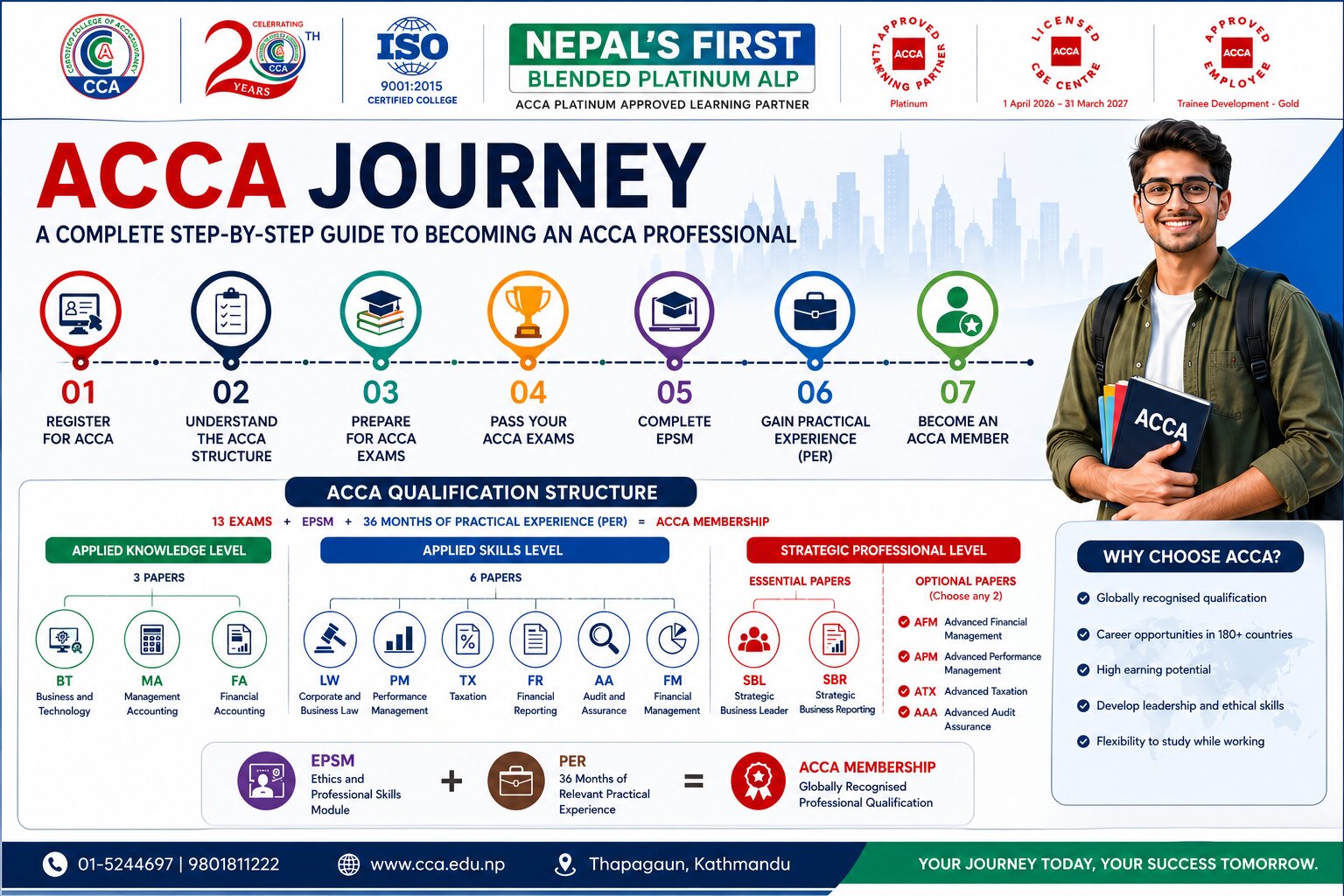
Starting your ACCA journey is one of the best decisions if you want a successful career in accounting, finance, auditing, taxation, or business management. The Association of Chartered Certified Accountants (ACCA) is a globally recognized professional accounting qualification accepted in more than 180 countries, making it an excellent choice for students and working professionals who want international career opportunities.
However, many students are unsure where to begin. Questions like “How do I register for ACCA?”, “How many exams do I need to pass?”, and “How long does the ACCA journey take?” are common.
First Understanding the ACCA Qualification
The ACCA qualification is designed to develop knowledge and practical skills in:
- Financial Accounting
- Management Accounting
- Audit and Assurance
- Taxation
- Financial Reporting
- Financial Management
- Business Strategy
- Corporate Governance
- Leadership
The qualification consists of three exam levels along with additional professional requirements.
Students who successfully complete the ACCA qualification become eligible for careers in:
- Public Accounting
- Audit Firms
- Commercial Banks
- Multinational Companies
- Consulting Firms
- Government Organizations
- NGOs
- Financial Institutions
Because ACCA follows international accounting standards, its qualification is recognized by employers worldwide.
Who Can Start the ACCA Journey?
One of the biggest advantages of ACCA is that students can begin from different educational backgrounds.
Generally, ACCA is suitable for:
- +2 (Intermediate/A-Level) graduates meeting the minimum entry requirements
- Bachelor’s degree students
- BBS, BBA, BBM, BIM, and finance graduates
- CA students
- Working professionals
- Experienced accountants
Students who already hold relevant academic qualifications may also receive exemptions from certain ACCA exams, reducing the total number of papers they need to complete.
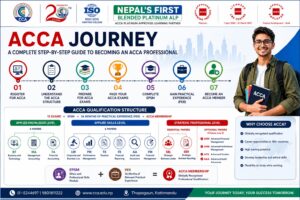
Step 1: Register for ACCA
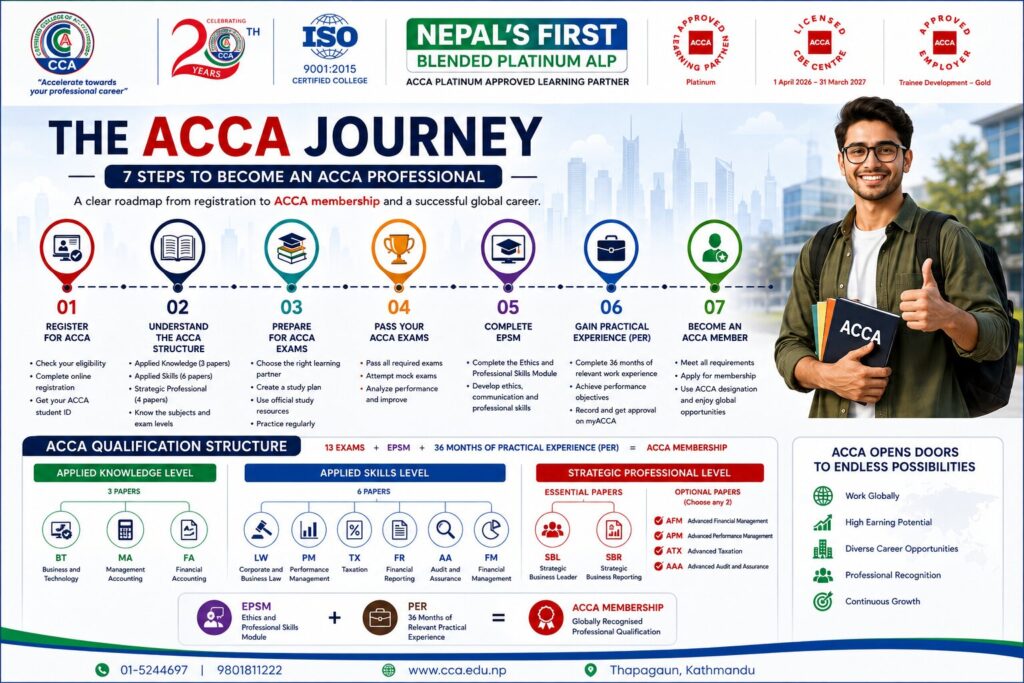
The first official step in your ACCA journey is registering as an ACCA student.
The registration process is completed online through the ACCA website.
Check Your Eligibility
Before registering, make sure you meet ACCA’s entry requirements.
Most students qualify through one of the following pathways:
- Higher Secondary (+2)
- A Levels
- Bachelor’s Degree
- Equivalent international qualifications
If you don’t meet the standard entry requirements, you may still be able to start through the Foundations in Accountancy (FIA) route before progressing to the ACCA qualification.
Students with prior accounting degrees may also receive exemptions based on their academic background.
Complete ACCA Registration
The registration process generally includes:
- Creating an ACCA account
- Completing the online application
- Uploading educational documents
- Uploading identification documents
- Paying the registration fee
- Receiving your ACCA student ID
After registration is approved, students gain access to the ACCA student portal, where they can manage exam bookings, study resources, exemptions, and results.
Step 2: Understand the ACCA Qualification Structure
Before preparing for exams, it’s important to understand how the qualification is organized.
The ACCA qualification consists of three levels.
Applied Knowledge Level
The Applied Knowledge level builds the foundation of accounting and business principles.
It introduces students to financial information, business operations, and management accounting.
The subjects include:
- Business and Technology (BT)
- Management Accounting (MA)
- Financial Accounting (FA)
This paper forms the core foundation for future ACCA subjects.
Applied Skills Level
The Applied Skills level develops the technical knowledge required by professional accountants.
Students study six subjects.
- Corporate and Business Law (LW)
- Performance Management (PM)
- Taxation (TX)
- Financial Reporting (FR)
- Audit and Assurance (AA)
- Financial Management (FM)
These skills are essential for financial decision-making.
Strategic Professional Level
The Strategic Professional level prepares students for senior leadership and strategic finance roles.
This level focuses on applying technical knowledge to complex business situations.
- Strategic Business Leader (SBL)
- Strategic Business Reporting (SBR)
Optional Papers
Students choose two optional papers based on their career goals.
Available options include:
- Advanced Financial Management (AFM)
- Advanced Performance Management (APM)
- Advanced Taxation (ATX)
- Advanced Audit and Assurance (AAA)
Choosing the right optional papers allows students to specialize in their preferred area of finance or accounting.
Step 3: Prepare for ACCA Exams
Success in ACCA depends not only on studying hard but also on studying smart.
A structured preparation strategy significantly improves exam performance.
Choose the Right Learning Partner
Choosing a quality learning provider can make a significant difference in your ACCA journey.
Students should look for an ACCA Approved Learning Partner that offers:
- Experienced ACCA-qualified tutors
- Structured classroom or online learning
- Mock examinations
- Revision classes
- Progress tracking
- Student support
- Access to quality study materials
For students in Nepal, CCA College is Nepal’s first ACCA Platinum Approved Learning Partner. The college provides experienced faculty, structured academic support, mock exams, and student mentoring designed to help learners progress through every stage of the ACCA qualification.
Create a Study Plan
A realistic study plan helps students stay consistent.
A good study schedule should include:
- Daily study hours
- Weekly revision sessions
- Practice questions
- Mock exams
- Time for weaker subjects
- Regular progress reviews
Breaking the syllabus into manageable sections makes preparation less overwhelming.
Use Official Study Resources
Students should rely on trusted and up-to-date study materials.
Useful resources include:
- ACCA Study Hub
- Official ACCA Practice Platform
- Approved study texts
- Approved revision kits
- Examiner reports
- Past exam papers
- Mock examinations
Practicing exam-standard questions regularly helps students become familiar with the ACCA exam format and improves confidence before exam day.
Step 4: Pass Your ACCA Exams
Passing the ACCA exams is one of the most important milestones in your ACCA journey. Each exam is designed to test not only your technical knowledge but also your ability to apply accounting and finance concepts to real-world business scenarios.
ACCA exams are held multiple times a year, allowing students to progress at a pace that suits their schedule. While some exams are available as on-demand computer-based exams, others are session-based exams conducted in March, June, September, and December.
How Many Exams Do You Need to Pass?
The total number of exams depends on whether you receive exemptions based on your previous qualifications.
Generally, the ACCA qualification consists of:
| Level | Number of Papers |
| Applied Knowledge | 3 |
| Applied Skills | 6 |
| Strategic Professional (Essential) | 2 |
| Strategic Professional (Optional) | 2 (Choose any two from four options) |
| Total | 13 Papers |
Students with relevant degrees in accounting, finance, or business may be eligible for exemptions from some Applied Knowledge or Applied Skills papers. The exact number of exemptions depends on ACCA’s exemption policy.
Remember that passing all required exams alone does not complete your ACCA qualification. You must also complete the Ethics and Professional Skills Module (EPSM) and the Practical Experience Requirement (PER) before becoming an ACCA member.
Tips to Improve Your Pass Rate
Passing ACCA exams requires consistent preparation rather than last-minute studying. The following strategies can significantly improve your chances of success:
Understand the Exam Format
Before starting your preparation, familiarize yourself with:
- Exam duration
- Question types
- Marks allocation
- Computer-based exam interface
- Technical articles published by ACCA
Knowing what to expect reduces exam-day stress and helps you prepare more effectively.
Practice Past Papers
Past papers are one of the best ways to prepare for ACCA exams. They help you:
- Understand examiner expectations
- Improve time management
- Identify common question patterns
- Build confidence
Attempt Mock Exams
Mock exams simulate the real exam environment and help you assess your readiness. They also highlight areas where you need additional revision before the actual exam.
Focus on Understanding, Not Memorization
Professional-level ACCA exams assess your ability to apply concepts in practical business situations. Instead of memorizing definitions, focus on understanding the underlying principles and how they are used in real-world scenarios.
Review Examiner Reports
ACCA examiner reports explain the most common mistakes students make. Reading these reports can help you avoid repeating similar errors and improve your overall exam technique.
Step 5: Complete the Ethics and Professional Skills Module (EPSM)
Technical knowledge alone is not enough to become a successful accountant. Employers also expect finance professionals to demonstrate ethical behavior, communication skills, leadership, and professional judgment.
This is why ACCA requires students to complete the Ethics and Professional Skills Module (EPSM).
What Is EPSM?
The Ethics and Professional Skills Module is an online learning program developed by ACCA to prepare students for today’s workplace.
The module focuses on practical professional skills such as:
- Ethical decision-making
- Professional skepticism
- Communication skills
- Leadership
- Problem-solving
- Commercial awareness
- Data analysis
- Innovation in business
Rather than traditional exams, the module uses interactive activities and real-life business scenarios to help students develop these essential workplace skills.
Why Is EPSM Important?
Completing EPSM provides several benefits throughout your ACCA journey.
It helps students:
- Develop ethical and professional judgment
- Improve workplace communication
- Strengthen decision-making skills
- Prepare for Strategic Professional exams
- Increase employability
Many employers value candidates who demonstrate both technical expertise and strong professional ethics, making EPSM an important part of becoming a well-rounded finance professional.
Step 6: Gain Practical Experience (PER)
Passing exams alone does not make someone an ACCA member. ACCA also requires students to gain practical workplace experience.
This requirement is known as the Practical Experience Requirement (PER).
PER ensures that students can apply what they have learned in real business environments before becoming fully qualified professionals.
What Is Practical Experience Requirement (PER)?
The Practical Experience Requirement (PER) requires students to complete 36 months of relevant work experience and achieve the required performance objectives.
The experience must involve accounting, finance, auditing, taxation, management, or other relevant business activities.
Students can complete PER:
- Before starting ACCA
- While studying ACCA
- After passing exams
This flexibility allows many students to study and work at the same time.
Types of Jobs That Count Toward PER
Various finance and accounting roles can contribute toward PER, provided they involve relevant responsibilities.
Examples include:
- Accountant
- Assistant Accountant
- Auditor
- Internal Auditor
- Tax Associate
- Finance Officer
- Financial Analyst
- Management Accountant
- Accounts Executive
- Finance Executive
Students should ensure their work experience aligns with ACCA’s performance objectives and is supervised by an appropriate mentor.
For students studying at CCA College, one additional advantage is that CCA is an ACCA Approved Employer, allowing eligible students to complete their Practical Experience Requirement (PER) through approved pathways while gaining valuable industry experience.
How to Record Your PER
Students record their Practical Experience Requirement through their myACCA account.
The process generally includes:
- Recording employment details
- Completing performance objectives
- Obtaining approval from a qualified workplace supervisor
- Updating work experience regularly
Keeping your PER records up to date makes the membership application process much smoother once all requirements have been completed.
Step 7: Become an ACCA Member
After completing all ACCA requirements, students can apply to become an official ACCA member.
Membership represents the successful completion of one of the world’s most respected professional accounting qualifications.
Requirements for ACCA Membership
To become an ACCA member, you must complete all of the following requirements:
- Pass all required ACCA exams (or receive approved exemptions where applicable)
- Complete the Ethics and Professional Skills Module (EPSM)
- Complete 36 months of Practical Experience Requirement (PER)
- Achieve all required performance objectives
- Apply for ACCA membership
Once your application is approved, you can officially use the designation ACCA after your name.
Benefits of Becoming an ACCA Member
Becoming an ACCA member opens the door to a wide range of career opportunities across industries and countries.
Some of the key benefits include:
- Global professional recognition
- Better career opportunities
- Higher earning potential
- Membership in an international professional network
- Continuous professional development (CPD)
- Opportunities to work in multinational companies
- Career progression into leadership and management roles
Many ACCA members go on to become Finance Managers, Auditors, Tax Consultants, Financial Controllers, Chief Financial Officers (CFOs), and business leaders in organizations around the world.
How Long Does the ACCA Journey Take?
The time required to complete the ACCA journey varies depending on your educational background, study schedule, exemptions, and exam success.
On average:
| Student Type | Estimated Duration |
| Full-time student | 3–4 years |
| Working professional | 4–5 years |
| Students with exemptions | 2–3 years (depending on the number of exemptions) |
Since students can choose how many exams to attempt in each session, the ACCA qualification offers flexibility to study at a pace that suits individual commitments.
Common Challenges During the ACCA Journey
Although ACCA is highly rewarding, students often face several challenges along the way.
Some common difficulties include:
- Managing a large syllabus
- Balancing studies with work or university
- Preparing for professional-level case study exams
- Staying motivated during long study periods
- Managing exam stress
- Financial planning for registration, exam, and tuition fees
- Understanding complex accounting and financial reporting concepts
Recognizing these challenges early allows students to develop effective study habits and seek support when needed.
Tips to Make Your ACCA Journey Easier
You can make your ACCA journey more manageable by following these practical tips:
- Create a realistic study timetable and stick to it.
- Study consistently instead of cramming before exams.
- Practice past papers and mock exams regularly.
- Focus on understanding concepts rather than memorizing answers.
- Read examiner reports to learn from common mistakes.
- Join study groups or discussion forums for peer support.
- Choose an experienced ACCA Approved Learning Partner for structured guidance.
- Maintain a healthy balance between study, work, and personal life to avoid burnout.
Consistency, discipline, and the right support system are key factors in successfully completing the ACCA qualification.
Conclusion
The ACCA journey is more than just passing exams—it’s a structured pathway to becoming a globally recognized finance professional. From registering as an ACCA student to completing exams, the Ethics and Professional Skills Module (EPSM), and the Practical Experience Requirement (PER), each stage helps you build the technical knowledge, practical experience, and professional skills employers value.
While the journey requires commitment and consistent effort, the long-term rewards are significant. ACCA members enjoy global recognition, diverse career opportunities, and the flexibility to work across industries and countries.
If you’re planning to begin your ACCA journey in Nepal, choosing the right learning partner can make a real difference. CCA College, Nepal’s first ACCA Platinum Approved Learning Partner and an ACCA Approved Employer, provides expert faculty, structured learning, mock exams, and student support to help you progress confidently toward becoming an ACCA professional.
Frequently Asked Questions (FAQs)
Can I complete ACCA while studying or working?
Yes. ACCA is designed to be flexible, allowing students to study alongside a university degree or full-time job. Many students successfully balance work and ACCA by following a structured study plan and taking a manageable number of exams each session.
Is the ACCA journey difficult?
The ACCA qualification is challenging because it covers a wide range of accounting, finance, and business topics. However, with consistent preparation, quality study materials, regular practice, and guidance from an experienced learning partner, students can successfully complete the qualification.
Can I become an ACCA member immediately after passing all exams?
No. Passing all ACCA exams is only one requirement. You must also complete the Ethics and Professional Skills Module (EPSM), fulfill the 36-month Practical Experience Requirement (PER), achieve the required performance objectives, and submit your membership application before becoming an ACCA member.
What happens after completing the ACCA journey?
After becoming an ACCA member, you can pursue careers in accounting, auditing, taxation, financial management, consulting, banking, and corporate finance. Many members work for multinational companies, public accounting firms, government organizations, and international businesses, while others continue their professional development through leadership roles or specialized finance careers.