
Choosing the right professional qualification is an important decision for anyone planning a career in accounting, finance, or business management. With the growing demand for skilled finance professionals, students are increasingly exploring internationally recognised qualifications that offer relevant knowledge, professional skills, and career opportunities. One popular option is the Association of Chartered Certified Accountants (ACCA).
The benefits of ACCA certificates and the professional qualification go beyond learning accounting principles. ACCA develops technical expertise, business understanding, strategic thinking, and professional ethics. Its international recognition, flexible learning options, and relevance across industries make it an attractive choice for aspiring accountants and finance professionals.
Whether you are a student planning to pursue ACCA after +2, a university graduate, or a working professional, understanding the advantages of ACCA can help you make an informed career decision
Why Choose to Study ACCA?
ACCA is a globally recognised professional accountancy qualification offered by the Association of Chartered Certified Accountants, established in 1904. It prepares individuals for careers in accounting, finance, auditing, taxation, and business management.
Unlike qualifications focused only on traditional accounting, ACCA combines financial knowledge with business strategy, financial reporting, management accounting, taxation, auditing, and professional ethics. This broader approach helps students understand how financial information supports business operations and decision-making.
Another important reason to choose ACCA is its international presence. With a professional community across 180 countries, ACCA connects students and members with employers and finance professionals worldwide. It can therefore be relevant for individuals interested in developing careers in their home countries or exploring international opportunities.
ACCA also offers flexible study options, allowing students to pursue full-time, part-time, online, or classroom-based learning. This makes it possible to balance professional studies with university education, employment, and personal commitments.
For students in Nepal, ACCA provides an opportunity to develop internationally relevant accounting and finance skills while exploring employment opportunities in Nepal and abroad.
Top Reasons to Choose ACCA
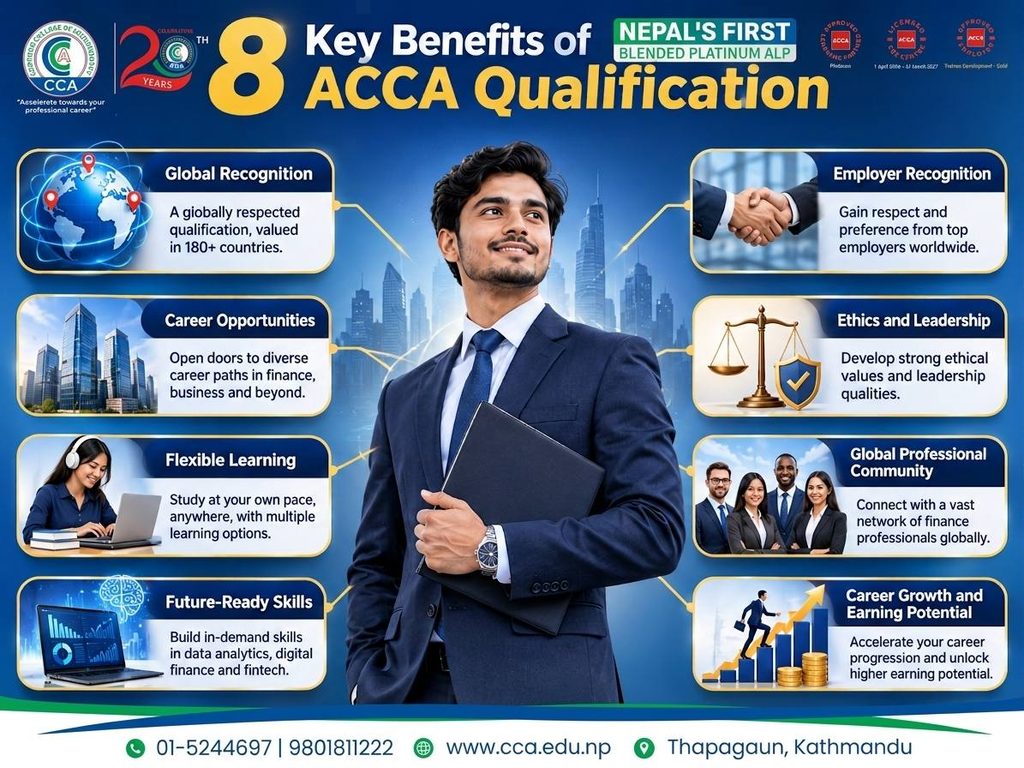
Here are eight important benefits of pursuing an ACCA qualification and how they can support your professional development.
1. Global Recognition and International Career Opportunities
One of the major benefits of pursuing an ACCA qualification is its international recognition. ACCA has a professional network spanning 180 countries, making it a well-established name in the global accounting and finance industry.
The qualification develops knowledge in financial reporting, auditing, taxation, financial management, and business strategy. These areas are relevant to organisations operating in different countries and industries.
For students in Nepal, this international recognition can help when exploring opportunities in international financial markets such as the UK, Australia, Canada, Singapore, and the UAE. It can also be valuable when applying to multinational companies and international accounting firms.
However, international recognition does not automatically guarantee employment, work visas, or statutory audit rights in every country. Local professional regulations and employer requirements may apply.
2. Career Opportunities Across Different Industries
Another significant advantage of ACCA is the range of industries where its knowledge can be applied. Accounting and financial management are essential functions in almost every organisation, creating opportunities beyond traditional accounting positions.
ACCA professionals can explore careers in:
- Banking and financial services: Financial analysis, risk management, credit control, and financial reporting.
- Audit and accounting firms: External auditing, internal auditing, taxation, and assurance services.
- Multinational companies: Financial management, budgeting, management accounting, and business analysis.
- Government and public sector: Public sector accounting, budgeting, financial control, and compliance.
- Consulting and advisory firms: Business advisory, risk assessment, corporate finance, and financial consulting.
- Non-profit organisations: Fund management, financial planning, and financial reporting.
This industry-wide relevance allows professionals to choose career paths based on their interests, experience, and long-term goals.
3. Flexible Learning and Examination Options
ACCA offers a flexible learning structure that allows students to choose study methods according to their schedules and learning preferences.
Students can pursue their studies through full-time classroom learning, part-time classes, online tuition, distance learning, or self-study. This flexibility makes ACCA suitable for +2 graduates, university students, and working professionals.
ACCA also provides different examination arrangements. Certain computer-based examinations are available on demand, while session-based examinations are conducted four times a year, in March, June, September, and December.
Students can plan their examination attempts according to their preparation and progress, subject to ACCA’s examination rules and availability.
For students in Nepal, this flexibility makes it easier to balance ACCA studies with university education, employment, and other responsibilities.
4. Develop Future-Ready Skills for the Finance Industry
The accounting and finance industry is continuously changing due to digital transformation, automation, data analytics, and evolving business requirements. Modern accountants need more than traditional bookkeeping and financial reporting knowledge.
ACCA helps students develop technical and professional skills relevant to these changes, including:
- Financial knowledge: Accounting, auditing, taxation, and financial management.
- Analytical skills: Interpreting financial information and evaluating business performance.
- Digital skills: Understanding financial technology, digital systems, and data.
- Strategic thinking: Assessing business risks and supporting organisational decisions.
- Sustainability awareness: Understanding sustainability-related risks and reporting.
These skills help prepare students for changing responsibilities in the modern finance profession. ACCA is also updating its qualification, with new Strategic Professional examinations scheduled to begin in September 2027, reflecting developments in areas such as data science and sustainability reporting.
5. Trusted by Employers and Improved Employability
Employer recognition is another important reason students choose ACCA. Organisations need finance professionals who understand accounting standards, financial reporting, business operations, and professional responsibilities.
ACCA reports working with more than 8,100 Approved Employers worldwide. These relationships demonstrate its connections with organisations in the international employment market.
Employers may value ACCA-trained professionals for their:
- Strong accounting and financial knowledge.
- Understanding of international accounting practices.
- Financial analysis and business decision-making abilities.
- Practical workplace experience.
- Professional ethics and responsibilities.
These competencies can strengthen a candidate’s profile when applying for accounting and finance positions.
However, completing ACCA examinations alone does not guarantee employment. Practical experience, communication skills, technical abilities, and job-specific knowledge are also important for improving employability.
6. Develop Professional Ethics and Leadership Skills
Professional accountants handle sensitive financial information, assess business risks, and support important organisational decisions. Therefore, integrity, accountability, and ethical judgement are essential qualities in the finance profession.
ACCA places significant emphasis on professional ethics through its qualification and Ethics and Professional Skills Module.
Students develop several important professional competencies, including:
- Ethical decision-making: Making responsible decisions based on professional standards and integrity.
- Critical thinking: Evaluating complex situations and identifying appropriate solutions.
- Communication: Presenting financial information clearly to colleagues, clients, and management.
- Leadership: Managing responsibilities and contributing to organisational objectives.
- Professional judgement: Applying technical knowledge to real business situations.
These skills can support career progression from accounting positions towards management and leadership roles.
7. Access to a Global Professional Community and Learning Support
Another benefit of ACCA is the opportunity to become part of an international community of accounting and finance professionals.
ACCA connects students and members with employers, learning providers, and professionals across different countries. This creates opportunities to develop professional relationships, exchange knowledge, and stay updated on industry developments.
ACCA also provides learning and career resources, including:
- Approved Learning Partners: Tuition providers offering classroom-based and online learning support.
- ACCA Study Hub: Digital study materials, learning chapters, flashcards, and practice questions.
- ACCA Careers: Access to accounting and finance job opportunities and career resources.
- Professional development: Learning materials, webinars, and updates to support continuous development.
- Networking opportunities: Events and professional communities that connect students and members.
These resources support students throughout their qualification journey and help members continue developing their professional knowledge.
8. Better Career Progression and Earning Potential
Pursuing ACCA can also support long-term career progression and earning potential in accounting and finance.
As professionals develop technical knowledge, gain practical experience, and build professional competencies, they may become eligible for more senior responsibilities.
Possible career opportunities include:
| Career stage | Potential job positions |
|---|---|
| Entry-level | Accounts Assistant, Audit Assistant |
| Intermediate | Financial Accountant, Management Accountant |
| Experienced | Financial Analyst, Finance Manager |
| Senior-level | Financial Controller, Finance Director |
| Executive-level | Chief Financial Officer (CFO) |
The exact career path depends on an individual’s experience, skills, performance, and employment opportunities.
Professionals with specialised knowledge and relevant experience may also qualify for higher-paying positions as they progress. However, ACCA does not guarantee a particular salary or promotion, as earnings vary by country, industry, employer, and job responsibilities.
It is also important to understand that completing ACCA examinations and becoming an ACCA member are different stages. Under the current membership requirements, individuals must complete the required examinations, Ethics and Professional Skills Module, and Practical Experience Requirement, including at least 36 months of relevant experience and nine performance objectives.
Conclusion
Pursuing an ACCA qualification offers several benefits for individuals planning careers in accounting, finance, and business management. Its international recognition, opportunities across different industries, flexible learning structure, and focus on future-ready skills make it a valuable professional development pathway.
For students in Nepal, ACCA can provide internationally relevant accounting knowledge and opportunities to explore local and international career markets. However, professional success requires more than passing examinations. Relevant work experience, technical expertise, communication skills, and ethical standards are equally important. For individuals interested in building a long-term career in finance, ACCA can provide a strong foundation for professional growth.
FAQs on the Benefits of Getting an ACCA Certification
Is ACCA certification worth it?
Yes, ACCA can be worth pursuing for individuals interested in careers in accounting, finance, auditing, taxation, and business management. It offers international professional recognition, relevant technical knowledge, flexible study options, and opportunities to develop professional skills.
Its value depends on your career goals, financial circumstances, study commitment, and willingness to gain practical experience.
Is ACCA equal to a degree?
ACCA is a professional accountancy qualification, not the same as a conventional university bachelor’s degree. However, parts of the qualification are benchmarked at academic qualification levels within the UK education framework. Eligible students may also have opportunities to pursue separate university awards through academic pathways associated with ACCA.
Academic recognition and equivalence depend on the relevant university, employer, and country’s regulations.
Is ACCA enough to get a job?
ACCA can improve employability by developing accounting knowledge, financial skills, and professional competencies. However, completing ACCA does not automatically guarantee employment.
Employers also consider practical experience, communication skills, technical abilities, and job-specific knowledge. Students should consider gaining relevant experience through internships or entry-level accounting and finance positions while studying.
What jobs are available after ACCA?
After completing the ACCA qualification and meeting the applicable membership requirements, individuals can explore various accounting and finance careers, including:
- Financial Accountant
- Management Accountant
- External Auditor
- Internal Auditor
- Tax Consultant
- Financial Analyst
- Finance Manager
- Financial Controller
- Chief Financial Officer (CFO)
The availability of these positions depends on professional experience, membership status, employer requirements, and relevant country-specific regulations.