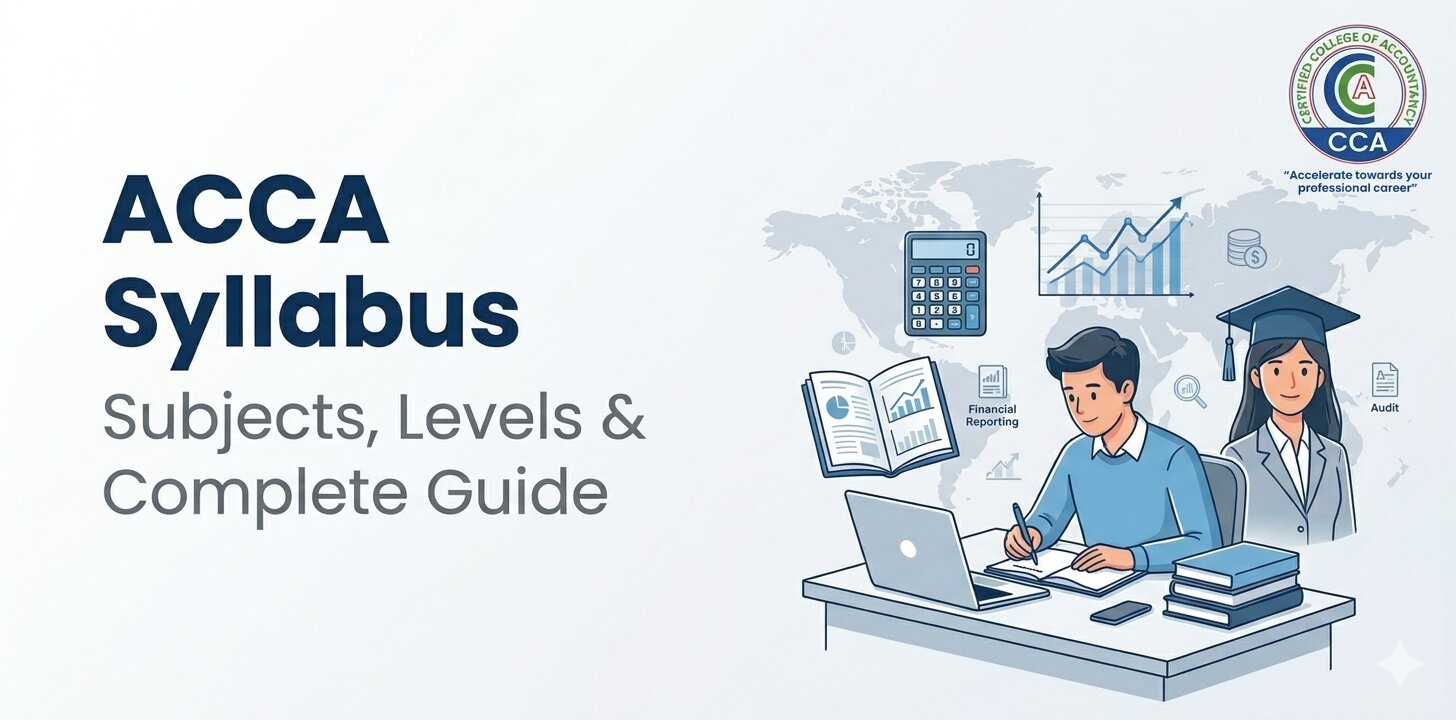
If you are planning to build a career in accounting and finance, understanding the ACCA syllabus is your first step. Whether you are a fresh +2 graduate or a working professional, this guide covers everything you need to know about ACCA Course, subjects, levels, exam structure, and what it means for students in Nepal.
The ACCA syllabus includes 13 papers divided into 3 levels, along with an Ethics and Professional Skills Module (EPSM) and a Practical Experience Requirement (PER), making it one of the most comprehensive accounting qualifications in the world.
What is the ACCA Syllabus?
The ACCA syllabus is the official framework of subjects and learning outcomes set by the Association of Chartered Certified Accountants (ACCA), a globally recognized professional accounting body based in the United Kingdom.
The syllabus is designed to take students from basic accounting concepts to advanced strategic financial thinking. It ensures that students develop technical, analytical, and professional skills required in global finance roles.
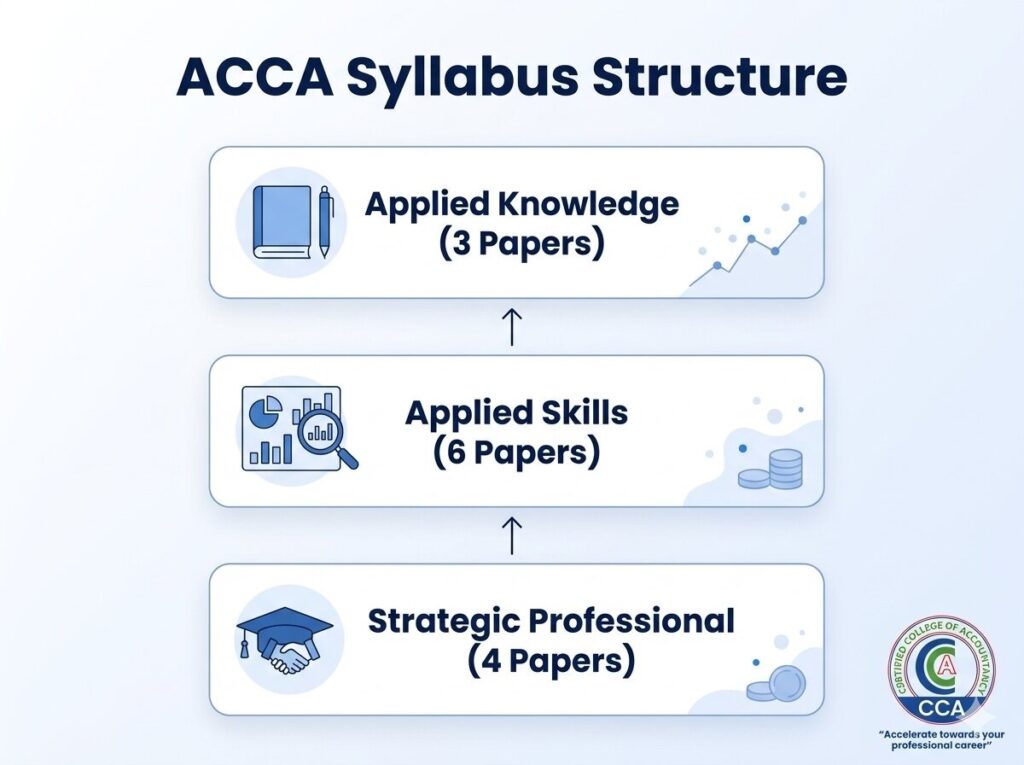
ACCA Course Structure Overview
The ACCA qualification is divided into three levels:
| Level | Number of Papers |
| Applied Knowledge | 3 Papers |
| Applied Skills | 6 Papers |
| Strategic Professional | 4 Papers |
Along with completing all exams, students must also finish the Ethics and Professional Skills Module (EPSM) and gain 36 months of relevant work experience (PER) before becoming a full ACCA member.
ACCA Subjects List
Here is a complete breakdown of ACCA subjects across all levels:
| Level | Papers | Subjects |
| Applied Knowledge | 3 | BT, MA, FA |
| Applied Skills | 6 | LW, PM, TX, FR, AA, FM |
| Strategic Professional | 4 | SBL, SBR + 2 Optional |
Applied Knowledge Level (3 Papers)
This is the entry level of the ACCA qualification. These papers build the foundation of accounting and business knowledge.
- Business and Technology (BT): Covers how organizations operate, corporate governance, and the role of technology.
- Management Accounting (MA): Focuses on costing, budgeting, and internal decision-making.
- Financial Accounting (FA): Teaches preparation of financial statements and recording transactions.
Applied Skills Level (6 Papers)
This level forms the technical core of the ACCA qualification and focuses on real-world application.
- Corporate and Business Law (LW): Covers legal systems, contract law, and company regulations.
- Performance Management (PM): Includes advanced costing and performance evaluation techniques.
- Taxation (TX): Covers income tax, corporate tax, VAT, and tax planning (UK variant in Nepal).
- Financial Reporting (FR): Focuses on IFRS-based financial statements and group accounting.
- Audit and Assurance (AA): Covers audit processes, risk assessment, and internal controls.
- Financial Management (FM): Includes investment decisions, risk management, and business valuation.
Strategic Professional Level (4 Papers)
This is the final level, focusing on leadership and strategic decision-making.
Essential Papers:
- Strategic Business Leader (SBL): A case-study-based exam testing leadership and strategy.
- Strategic Business Reporting (SBR): Advanced financial reporting and analysis.
Optional Papers (Choose 2):
- Advanced Financial Management (AFM)
- Advanced Performance Management (APM)
- Advanced Taxation (ATX)
- Advanced Audit and Assurance (AAA)
ACCA Exam Pattern & Passing Criteria
- Pass Mark: 50% for every paper
- Exam Type: Computer-Based Exams (CBE)
- Exam Sessions: March, June, September, December
| Level | Format | Duration |
| Applied Knowledge | CBE | 2 hours |
| Applied Skills | CBE | 3 hours |
| Strategic Business Leader | CBE | 4 hours |
| Other Strategic Professional | CBE | 3 hours 15 minutes |
Results for Applied Knowledge papers are available immediately, while other results are released within 6–8 weeks.
How Long Does It Take to Complete ACCA Syllabus?
The time required to complete the ACCA syllabus depends on your background and exemptions:
- Without exemptions: 3–4 years
- With exemptions: 1.5–3 years
- Fast-track students: Can complete faster with proper planning
Students can also complete their Practical Experience Requirement (PER) alongside studies, reducing total time.
ACCA Exemptions & Entry Requirements
Minimum Entry Requirements
Students in Nepal who have completed +2 (Grade 12) with Mathematics and English can register for ACCA.
Exemptions
- Up to 9 papers can be exempted
- Available for BBA, B.Com, and CA students
- No exemptions for Strategic Professional level
Exemptions reduce the number of exams but require a fee per paper.
Skills You Gain from ACCA Subjects
The ACCA syllabus develops both technical and professional skills:
- Financial Expertise: Accounting, taxation, audit, and finance
- Strategic Thinking: Business decision-making and leadership
- Ethical Judgment: Professional ethics and integrity
- Digital Skills: Data analytics and modern finance tools
- Communication Skills: Leadership and stakeholder management
ACCA Syllabus in Nepal: What Students Should Know
Same Global Syllabus
The ACCA syllabus in Nepal is identical to the global syllabus, ensuring international recognition.
Exam Availability
Students can sit exams in Nepal through approved CBE centers, especially in Kathmandu.
Career Opportunities
ACCA professionals are in demand in:
- Accounting firms
- Banks
- Multinational companies
- International organizations
Many students also pursue careers abroad in countries like the UK, Australia, and the Middle East.
Conclusion
The ACCA syllabus is designed to build world-class accounting professionals with strong technical and strategic skills. With the right approach, planning, and guidance, students in Nepal can successfully complete the ACCA qualification and build a global career in finance.
FAQs About ACCA Syllabus
How many subjects are in ACCA?
There are 13 papers across three levels, plus EPSM and PER requirements.
Is the ACCA syllabus the same in Nepal?
Yes, the syllabus is globally standardized, with only minor variations like the Taxation paper.
How long does it take to complete ACCA?
It usually takes 2–4 years depending on exemptions and study pace.
What is the passing mark for ACCA exams?
The passing mark is 50% for all papers.
Is ACCA difficult?
ACCA is challenging but manageable with proper preparation and guidance.
Which ACCA subject is the hardest?
Subjects like Financial Reporting (FR) and Strategic Business Leader (SBL) are often considered more difficult.
Do I need to study the entire ACCA syllabus for each exam?
Yes, all topics are examinable, so full coverage is important.