Understanding Your Position After ACCA
Completing the ACCA qualification is a significant milestone, but it is also just the beginning of a larger professional journey. Before deciding what to do next, it is essential to understand exactly where you stand and what the ACCA qualification truly gives you.
What ACCA Qualification Actually Gives You
The ACCA (Association of Chartered Certified Accountants) qualification consists of 13 exams spread across three levels: Applied Knowledge, Applied Skills, and Strategic Professional. When you pass all 13 exams, you officially become an ACCA Affiliate, a status that signals you have mastered the academic and technical component of one of the world’s most rigorous finance qualifications.
ACCA is recognised in over 180 countries and has a global community of more than 241,000 members and 542,000 future members. As an Affiliate, your qualification demonstrates competency across financial reporting, taxation, audit and assurance, financial management, and strategic business leadership. Employers – particularly Big Four firms, multinational corporations, and global financial institutions – actively recognise the rigour behind the ACCA exams.
However, there is an important distinction to understand clearly: an Affiliate is not yet a fully qualified ACCA Member. While you can work in accounting and finance roles, you must do so under the supervision of qualified professionals until full membership is granted.
The Importance of PER (Practical Experience Requirement)
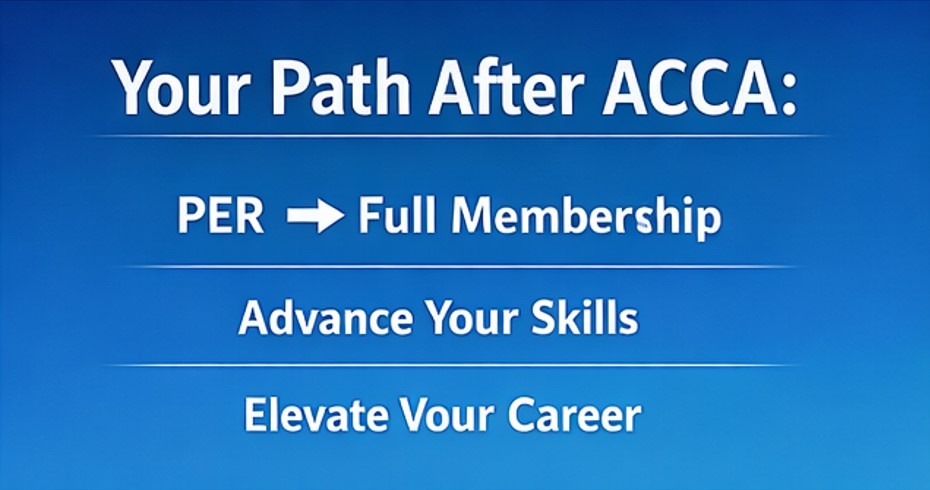
The single most important thing you must do after passing your ACCA exams is complete the Practical Experience Requirement (PER). Without a completed PER, you cannot become an ACCA Member, regardless of how many exams you have passed.
The PER requires a minimum of 36 months of supervised, relevant work experience in an accounting or finance-related role. This experience can be gained before, during, or after your exams. Alongside the time requirement, you must demonstrate competency across nine performance objectives – five Essential objectives and four Technical objectives. You must also complete the Ethics and Professional Skills Module (EPSM), all tracked through ACCA’s MyExperience portal.
One of the most costly mistakes Affiliates make is deprioritising PER. The 36-month clock can run in parallel with your exam journey. If you have not started recording your PER yet, start today.
Is ACCA Enough to Build a Successful Career?
The answer is nuanced: yes, ACCA is more than sufficient for a strong career, but only if you use it strategically.
Full ACCA membership opens doors to senior roles including Chief Financial Officer, Finance Director, Head of Audit, Tax Partner, and Strategic Finance Manager. According to ACCA’s own reports, members’ salaries are on average 15-20% higher than those of Affiliates.
That said, the finance profession is evolving rapidly. Professionals who layer in additional qualifications or technology skills tend to accelerate significantly faster. The question is not whether ACCA is enough – it is whether you are making the most of what it gives you.
High-Growth Career Paths for ACCA Professionals
ACCA unlocks a broad range of career directions across virtually every sector globally. However, it is important to realize that your journey often starts with the choices you made during your final exams. Your Strategic Professional Options (e.g., AFM vs. ATX) significantly dictate your initial job hunt. For instance, if you took Advanced Audit (AAA), you are much more ‘plug-and-play’ for Big Four firms, whereas Advanced Financial Management (AFM) makes you a prime candidate for treasury or corporate finance roles.
Common destinations include:
- Corporate Finance and Financial Reporting: Strong opportunities in treasury and FP&A.
- Audit and Assurance: Structured progression within Big Four and mid-tier firms.
- Taxation: A high-demand area, particularly for those with the ATX module.
- Risk Management: Governance and compliance roles in banking.
After ACCA, Which Course Is Better? (Best Options Explained)
The right answer depends entirely on the career direction you are pursuing. Here are the most respected and practically valuable options available in 2026.
CFA (Chartered Financial Analyst)
If your ambition lies in investment banking, asset management, or portfolio management, the CFA designation offered by the CFA Institute is the natural next step after ACCA.
The CFA programme consists of three levels, each requiring approximately 300-400 hours of study. Most candidates take between two and four years to complete all three levels. There are no exam exemptions for ACCA holders within the CFA programme – all candidates sit for all three levels. However, your ACCA background provides a genuine study advantage at Level 1, where financial reporting and ethics topics overlap significantly with the ACCA curriculum.
The ACCA and CFA combination is particularly powerful. ACCA builds mastery over accounting and financial reporting; CFA adds specialised depth in investment analysis and portfolio strategy. Together, they position you for the highest levels of global finance.
MSc in Professional Accountancy (University of London)
For ACCA members and Affiliates who want to add a prestigious academic master’s degree without interrupting their career, the MSc in Professional Accountancy from the University of London is an excellent option.
The programme is developed and taught by academics from University College London’s (UCL) School of Management. ACCA’s partnership with the University of London means that as an ACCA member or Affiliate, you only need to complete three modules, including a compulsory Capstone project, to earn the full MSc. You can study entirely online and the programme can be completed in as little as six months.
MBA in Finance or Strategic Leadership
An MBA from a well-regarded business school remains one of the most powerful career accelerators for ACCA professionals targeting C-suite leadership or general management roles beyond pure finance. Many leading business schools recognise ACCA as equivalent to a professional degree for MBA admission purposes.
CIA (Certified Internal Auditor) or CISA
If your career path leads towards internal audit or IT audit, the Certified Internal Auditor (CIA) and Certified Information Systems Auditor (CISA) certifications are worth serious consideration. The CIA is the global gold standard in internal auditing, while CISA is particularly relevant for professionals working in IT audit, information security, and digital systems governance.
Why You Should Combine ACCA with Technology Skills
The accounting and finance profession is undergoing one of the most significant transformations in its history. Automated bookkeeping, AI-powered audit tools, and data-driven financial reporting are present realities in modern finance teams.
Finance professionals who combine ACCA credentials with strong technology capabilities are not just more hireable – they are more promotable. This is not about becoming a software developer. It is about becoming a finance professional who can operate effectively in a data-rich environment and communicate insights through modern tools.
Best Data and Reporting Skills to Learn After ACCA
Excel Advanced Skills (VBA and Macros)
Excel remains the universal language of finance. Advanced Excel skills – including VBA, macros, pivot tables, dynamic arrays, and Power Query – allow you to automate repetitive tasks, build sophisticated financial models, and process large datasets efficiently. These skills translate directly into faster month-end closes and more reliable models.
Power BI and Data Analytics Tools
Power BI is rapidly becoming the standard data visualisation tool in corporate finance environments. It allows finance professionals to connect to multiple data sources, build interactive dashboards, and communicate financial insights to non-finance stakeholders with clarity. Microsoft offers an official Power BI certification pathway achievable within a few months of dedicated practice.
Python for Finance
Python has emerged as the most accessible programming language in finance, particularly for financial modelling, data analysis, and risk analytics. Libraries such as Pandas, NumPy, and Matplotlib allow you to manipulate large financial datasets and automate reporting workflows at a scale that Excel cannot match. Platforms such as DataCamp, Kaggle, and Coursera offer finance-specific Python courses that build practical skills efficiently.
Practical Steps: From Affiliate to Global Member
The path from Affiliate to full ACCA Member requires three things: 36 months of supervised work experience, nine performance objectives signed off by a qualified supervisor, and completion of the Ethics and Professional Skills Module.
Start your PER as early as possible and log your progress regularly through ACCA’s MyExperience portal. Complete the Ethics and Professional Skills Module early rather than leaving it to the end. Once all requirements are fulfilled, submit your membership application through the ACCA portal.
Beyond the paperwork, don’t forget the power of the “Hidden Job Market.” In 2026, being an Affiliate is a great credential, but your LinkedIn presence and active engagement with your local ACCA chapter will often land you a job faster than a certificate alone. Employers are looking for the person behind the qualification; networking turns your digital profile into a professional personality.
Common Mistakes ACCA Affiliates Make
The single biggest mistake is treating the PER as something to address after all exams are done. By then, you may have lost 12 to 24 months of potential qualifying experience.
Allowing your ACCA affiliate subscription to lapse is another costly error. Without an active subscription, your affiliate status becomes inactive and creates complications when applying for full membership.
Neglecting technology skills in favour of purely technical accountancy development is a growing career risk. Affiliates who build data analytics capabilities will be significantly better positioned for senior roles in the years ahead.
Should You Work First or Study Further After ACCA?
If you have not yet started your PER, working first is the stronger choice. You need 36 months of supervised experience to become a full member, and delaying work to pursue further study means delaying membership.
If you are already mid-way through your PER, combining work with part-time further study is entirely achievable. Many successful ACCA professionals study part-time while working, particularly given the flexibility of online programmes.
The worst outcome is spending years in further study while your PER stalls. Work first, document your experience consistently, and layer in further study in a way that complements rather than replaces your professional development.
Conclusion: What Should You Do After ACCA?
Completing your ACCA exams is an achievement worth recognising, but it is the foundation, not the finish line. In 2026, the ACCA qualification positions you at the threshold of a genuinely global finance career.
Start with the essentials: prioritise your PER, complete the Ethics and Professional Skills Module, and apply for full ACCA membership. Choose your further study based on where you want to go. The CFA is the right choice for capital markets and investment careers. The University of London MSc is ideal if you want a prestigious academic postgraduate degree. An MBA suits leadership and general management ambitions. CIA or CISA is the right choice for internal audit professionals.
Build technology skills in parallel. Advanced Excel, Power BI, and Python for finance are increasingly baseline expectations in competitive roles. Use ACCA’s resources, build your network, and make deliberate job moves aligned with your long-term goals.
The ACCA qualification gives you a remarkable set of tools. The career you build with them is entirely up to you.